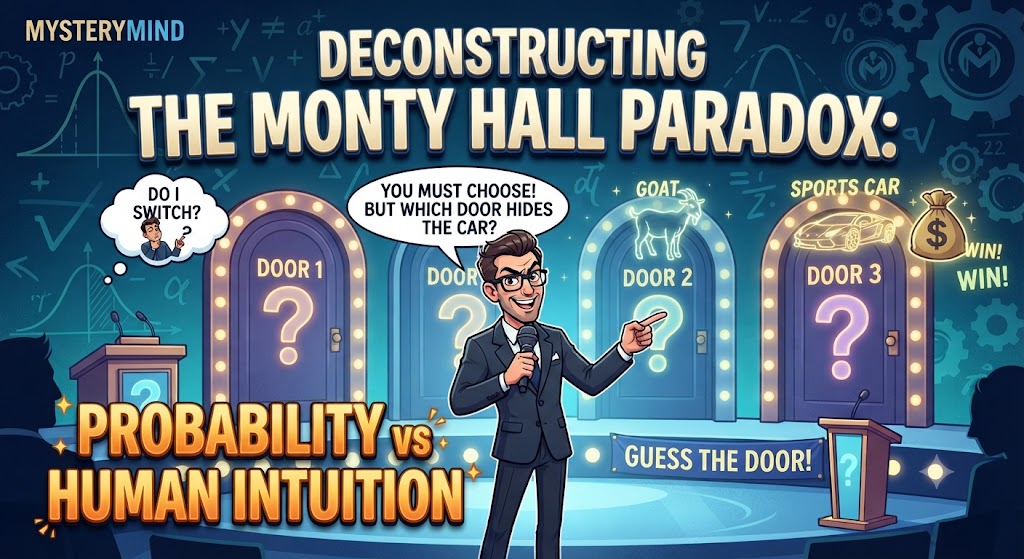
1. The Anatomy of a Cognitive Crisis: History of the Monty Hall Dilemma
In September 1990, Marilyn vos Savant—renowned for recording the highest recorded IQ in the Guinness Book of World Records—answered a reader’s question in her weekly Parade magazine column. The inquiry concerned a television game show scenario loosely modeled after Monty Hall’s classic program Let’s Make a Deal:
“Suppose you’re on a game show, and you’re given the choice of three doors: Behind one door is a car; behind the others, goats. You pick a door, say No. 1, and the host, who knows what’s behind the doors, opens another door, say No. 3, which has a goat. He then says to you, ‘Do you want to pick door No. 2?’ Is it to your advantage to switch your choice?”
Vos Savant responded with an unambiguous mathematical recommendation: Yes, you should switch; door No. 2 has a 2/3 probability of winning the car, while door No. 1 has only a 1/3 probability.
What followed was unprecedented in the annals of popular science. Over 10,000 readers wrote furious letters condemning vos Savant, including approximately 1,000 holders of PhD degrees in mathematics, statistics, and engineering. Respected university professors publicly accused her of mathematical illiteracy, condescendingly demanding that she retract her statement and apologize for misleading the public. Even the legendary mathematician Paul Erdős—one of the most prolific minds in combinatorial history—adamantly refused to believe switching conferred any advantage until he was shown computer simulations running tens of thousands of Monte Carlo trials!
Why did a simple probability problem trigger such universal, emotionally charged intellectual rebellion among world-class mathematical minds? The answer lies in the deep neurobiological mismatch between human evolutionary heuristics and formal Bayesian conditional probability.
2. The Formal Mathematical Proof: Bayesian Conditional Updating
To resolve the paradox rigorously, one must apply Bayes’ Theorem and carefully define the host’s behavior and information constraints:
Core Rules of the Standard Problem:
1. Exactly one door conceals the prize car; the other two conceal goats.
2. The contestant’s initial choice is purely random (P = 1/3 for each door).
3. The host, Monty Hall, knows the true location of the car.
4. Monty must always open an unchosen door to reveal a goat (never the car).
5. Monty must always offer the contestant the choice to switch.
The Prior Probabilities: Let $C_1, C_2, C_3$ denote the events that the car is behind Door 1, Door 2, or Door 3, respectively. Before any action, $P(C_1) = P(C_2) = P(C_3) = 1/3$.
Assume without loss of generality that the contestant picks Door 1. Let $M_3$ be the event that Monty opens Door 3 revealing a goat. We seek the posterior probability $P(C_2 | M_3)$—the probability the car is behind Door 2 given Monty opened Door 3:
$$P(C_2 | M_3) = \frac{P(M_3 | C_2) \cdot P(C_2)}{P(M_3)}$$
Now, evaluate each term:
• If the car is behind Door 2 ($C_2$), Monty is strictly forbidden from opening Door 1 (chosen by contestant) and cannot open Door 2 (contains the car). Therefore, Monty must open Door 3. Hence, $P(M_3 | C_2) = 1.0$.
• If the car is behind Door 1 ($C_1$), Monty can freely open either Door 2 or Door 3 (both have goats). Assuming a fair coin flip, $P(M_3 | C_1) = 1/2$.
• If the car is behind Door 3 ($C_3$), Monty cannot open Door 3; thus $P(M_3 | C_3) = 0$.
By the Law of Total Probability: $$P(M_3) = P(M_3 | C_1)P(C_1) + P(M_3 | C_2)P(C_2) + P(M_3 | C_3)P(C_3)$$ $$P(M_3) = (1/2)(1/3) + (1)(1/3) + (0)(1/3) = 1/6 + 1/3 = 1/2$$
Now substitute these values into Bayes’ formula: $$P(C_2 | M_3) = \frac{(1) \cdot (1/3)}{1/2} = \frac{2}{3}$$ $$P(C_1 | M_3) = \frac{(1/2) \cdot (1/3)}{1/2} = \frac{1}{3}$$
Switching doubles your winning probability from 33.3% to 66.7%!
3. Neurocognitive Mechanisms: The Equal Probability Fallacy and Bounded Rationality
Why does the human brain almost universally conclude that the remaining two doors have a 50/50 chance? Cognitive neuroscience identifies several profound heuristic traps hardwired into our neural architecture:
1. The “Equal Probability” (Uniformity) Heuristic: When presented with two closed alternatives, the brain’s intuitive System 1 automatically applies Laplace’s principle of indifference: “There are two doors left, so the probability must be 50% each.” This heuristic is computationally cheap and functions well in symmetric coin flips. However, it fails catastrophically in asymmetric conditional environments where past historical events (the host’s deliberate avoidance of the prize door) concentrate probability mass onto the unchosen door.
2. Neglect of the Host’s Constrained Behavior: Untrained thinkers view Monty’s action as a passive, random event. They fail to encode the vital reality that Monty’s choice is informationally constrained. If Monty had picked a random door that happened to reveal a goat by sheer accident (the “Monty Fall” variant), the probabilities would indeed collapse to 1/2 each. But because Monty acts with omniscient knowledge, his action filters out uncertainty, transferring the 2/3 probability of the entire unchosen set directly onto the single remaining door.
3. The 100-Door Intuitive Breakthrough: To shatter the intuitive resistance of the human brain, cognitive scientists use extreme scale expansion: Imagine 1,000 doors. You pick Door 1. You have a 1 in 1,000 chance of being right. Monty then walks along the line and swings open 998 doors, leaving only Door 743 closed. Do you switch? Instantly, every human brain perceives the truth: Monty deliberately skipped Door 743 because the car is almost certainly there! The 3-door scenario operates on the exact same mathematical logic.
4. Neuroeconomics: Loss Aversion, Regret Anticipation, and Status Quo Bias
Even when participants are intellectually convinced of the 2/3 mathematical advantage, empirical behavioral economics experiments demonstrate that a significant percentage still refuse to switch in real-money games! This irrational choice is driven by distinct emotional neurocircuits:
The Asymmetry of Regret (Kahneman & Tversky): In behavioral decision theory, counterfactual regret is felt twice as intensely when it results from an action (commission) compared to an inaction (omission). If a contestant sticks with their original door and loses, they experience moderate disappointment (“It was my bad luck”). But if a contestant switches away from their original door and discovers their first choice was the car, they experience agonizing, visceral self-blame (“I had it in my hands and gave it away!”).
Amygdala Activation and Insular Disgust: Functional neuroimaging reveals that the prospect of switching away from an initial choice activates the bilateral amygdala and anterior insula—the primary neural substrates of threat, pain, and disgust. To avoid this anticipated emotional punishment, the ventromedial prefrontal cortex (vmPFC) succumbs to the Status Quo Bias, sacrificing expected mathematical value to avoid psychological regret.
Endowment Effect on Abstract Choices: The moment a contestant points to Door 1, the brain experiences a micro-endowment effect: the chosen door is psychologically encoded as personal property (“my door”). Relinquishing it feels like surrendering an owned asset, triggering loss-averse resistance.
5. Real-World Applications: Medical Diagnostics, Machine Learning, and Strategy
The Monty Hall paradox is not an idle parlor trick; it is the ultimate stress test for conditional probabilistic reasoning across high-stakes professions:
Medical Diagnostic Screening: When a physician evaluates a patient who tests positive for a rare disease, the probability the patient actually has the condition depends heavily on the base rate (prior probability) and false-positive rates. Clinicians who commit the base-rate neglect fallacy (the exact medical analog of the Monty Hall uniformity heuristic) prescribe unnecessary, aggressive treatments to healthy individuals whose true posterior probability of illness is under 5%.
Bayesian Machine Learning Classifiers: Modern natural language processing and spam filters continuously update prior feature weights based on observed tokens using Bayes’ rule. Understanding how non-independent observations alter conditional distributions is fundamental to preventing algorithmic drift and bias.
Corporate Mergers & Acquisitions (The Winner’s Curse): In competitive bidding for distressed companies, acquiring firms frequently overlook that their bid only wins when every other competitor assessed the asset at a lower value. Failing to update probability estimates based on competitors’ decisions results in catastrophic overpayment.
Comparative Neuroanalytical Framework
To quantify the physiological, metabolic, and behavioral divergence across attentional states, the following high-density comparative matrix contrasts baseline operations against acute focus trajectories:
Actionable Clinical & Cognitive Protocols
Translating neurobiological theory into measurable intellectual performance requires standardized behavioral frameworks designed to optimize synaptic signaling and preserve metabolic substrates:
Protocol 1: Bayesian Deconstruction of Asymmetric Information
Whenever analyzing an unexpected outcome or update in business or science, ask: “Was the observer or agent who revealed this information constrained, or acting at random?” If an actor with privileged knowledge deliberately selects which data points to show you, do not treat the remaining options symmetrically. Calculate the selective filtration bias.
Protocol 2: The “Scale-to-Infinity” Mental Simulation
When your intuitive gut feeling conflicts with mathematical probability, artificially expand the parameters by a factor of 1,000. In the Monty Hall problem, imagine picking 1 door out of 1,000, and the host opening 998 goats. When a probability problem is scaled up, the underlying structural mechanics become visually and intuitively obvious, bypassing the prefrontal uniformity trap.
Protocol 3: Decoupling Emotional Regret from Expected Value
In strategic negotiations and portfolio management, consciously recognize the amygdala’s bias toward omission over commission. Pre-commit to decisions based strictly on mathematical Expected Value (EV = Probability x Payoff). Write down your decision criteria before the reveal to eliminate the status quo bias and prevent post-hoc rationalizations.
Protocol 4: Monte Carlo Algorithmic Verification
Never debate probability through intuition alone. When faced with complex conditional scenarios (such as drug screening trials or algorithmic trading strategies), write a 10-line Python simulation modeling 100,000 iterations. Observing empirical convergence on simulated data overrides stubborn cognitive biases faster than theoretical proofs.
Common Neuromyths, Pitfalls & Diagnostic Misattributions
- The “Monty Fall” Assumption: Assuming Monty opened the door accidentally or without knowing what was behind it. If the host slips and accidentally opens a door that happens to show a goat, switching offers no advantage (50/50). The advantage exists solely because the host’s action is an intentional, informed filter.
- The Gambler’s Fallacy in Conditional Updates: Believing that past events have no bearing on current probabilities in dependent sequences. While true for independent dice rolls, conditional updates in closed systems permanently alter the probability distribution of remaining candidates.
- Overconfidence of Highly Educated Professionals: The Monty Hall controversy proved that advanced academic credentials do not protect against cognitive illusions. In fact, mathematicians who relied on basic combinations without applying conditional constraints were the most vehemently dogmatic in their erroneous defense.
- Equating Outcome with Decision Quality: If an individual switches and happens to uncover a goat (which occurs 33.3% of the time), they often declare the decision was foolish. This is the Outcome Bias. A decision is evaluated by the mathematical rigor of the process at the moment it was made, not by random single-trial variance.
Frequently Asked Clinical Questions (FAQ)
What if Monty Hall only offers the switch when the contestant picked the car?
If the host is malicious and only offers the switch when you originally picked the car (to trick you into losing), switching would result in a 100% loss! This is why the standard mathematical formulation explicitly dictates that the host is legally bound to open a goat door and offer the switch on 100% of shows regardless of initial choice.
Why didn’t Paul Erdős believe the solution at first?
Paul Erdős was a pure combinatorics genius whose mental frameworks operated on formal mathematical elegance. Like many mathematicians, he initially conceptualized the two remaining doors as a newly created state with two symmetric possibilities (1/2 each). It was only when his colleague Ronald Graham demonstrated a computer simulation with hundreds of trials that Erdős accepted the Bayesian proof.
Does switching guarantee that I will win?
No. Switching guarantees a 2/3 (66.7%) probability of winning, which means you will still lose 1 out of every 3 games. In probabilistic decision theory, you cannot eliminate variance on an individual trial; you can only align your actions with the highest expected value over repeated trials.
How does the Monty Hall problem apply to medical testing?
Consider mammography: if a cancer has a 1% prevalence, and a mammogram has a 90% sensitivity with a 9% false-positive rate, a positive test does not mean a 90% chance of cancer. Applying Bayes’ theorem reveals the actual probability is roughly 9%. Failing to understand this causes immense psychological trauma and unnecessary invasive biopsies.
Why is human intuition so poorly adapted to probability?
Evolutionary ancestral environments operated in the physical world of deterministic Newtonian mechanics (e.g., throwing a spear, tracking an animal) and small sample sizes. Abstract conditional probability, large-number laws, and counterfactual Bayesian trees never existed in nature. Our brains rely on quick heuristics (availability, representativeness) that fail in formal probabilistic systems.
Peer-Reviewed Scholarly References
- vos Savant, M. (1990). Ask Marilyn. Parade Magazine, Sept 9, 1990.
- Selvin, S. (1975). A problem in probability. The American Statistician, 29(1), 67-71.
- Kahneman, D., & Tversky, A. (1982). The simulation heuristic. In Judgment Under Uncertainty: Heuristics and Biases (pp. 201-208). Cambridge University Press.
- Krauss, S., & Wang, X. T. (2003). The psychology of the Monty Hall problem: Discovering psychological mechanisms for solving a tenacious brain teaser. Journal of Experimental Psychology: General, 132(1), 3-22.
- Gigerenzer, G. (2002). Calculated Risks: How to Know When Numbers Deceive You. Simon and Schuster.
- Bar-Hillel, M., & Falk, R. (1982). Some teasers concerning conditional probabilities. Cognition, 11(2), 109-122.
- Samuelson, W., & Zeckhauser, R. (1988). Status quo bias in decision making. Journal of Risk and Uncertainty, 1(1), 7-59.