1. Theoretical Foundations: Shane Frederick’s Deceptively Simple Triad
In 2005, behavioral economist Shane Frederick published a landmark paper in the Journal of Economic Perspectives introducing what is now widely considered the world’s shortest, yet most psychometrically revealing, cognitive assessment: The Cognitive Reflection Test (CRT).
Unlike traditional intelligence batteries that consume hours of grueling calculation, the original CRT consists of merely three elementary questions:
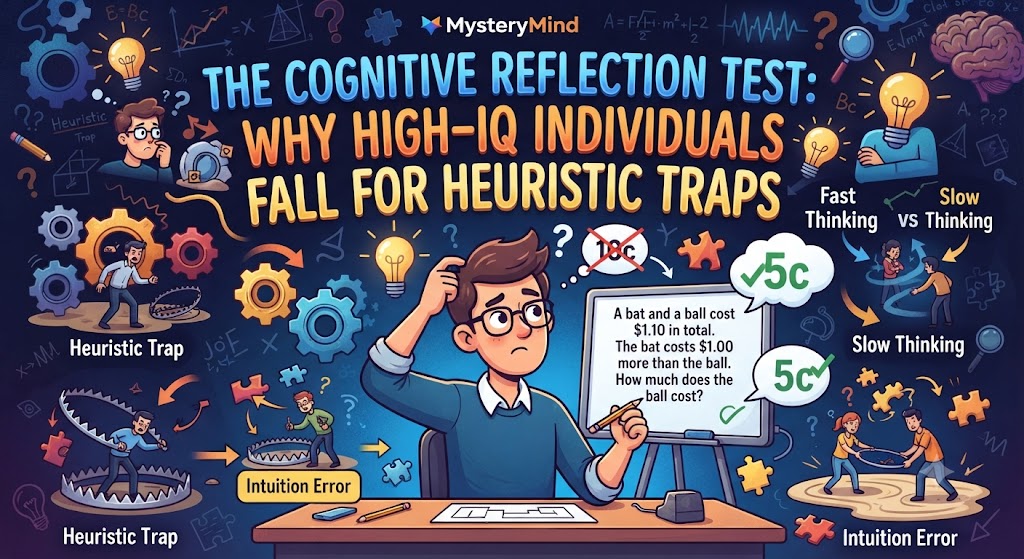
1. The Bat-and-Ball Problem: “A bat and a ball cost $1.10 in total. The bat costs $1.00 more than the ball. How much does the ball cost?”
2. The Widget Machines: “If it takes 5 machines 5 minutes to make 5 widgets, how long would it take 100 machines to make 100 widgets?”
3. The Lily Pad Patch: “In a lake, there is a patch of lily pads. Every day, the patch doubles in size. If it takes 48 days for the patch to cover the entire lake, how long would it take for the patch to cover half of the lake?”
The genius of these problems lies in their cognitive architecture: each question instantly, almost magnetically, evokes an intuitive, highly fluent, and emotionally satisfying answer that is flatly incorrect.
• For the bat and ball, the intuitive answer is 10 cents (the correct mathematical answer is 5 cents: $1.05 + $0.05 = $1.10).
• For the machines, the intuitive answer is 100 minutes (the correct answer is 5 minutes: 1 machine takes 5 minutes per widget).
• For the lily pads, the intuitive answer is 24 days (the correct answer is 47 days: doubling daily means it was half-covered the day before).
When Frederick administered this triad to thousands of university undergraduates across elite institutions—including MIT, Harvard, and Princeton—the results shocked the academic community: fewer than 17% of participants answered all three correctly, and over 33% failed all three entirely! Why do some of the brightest minds on earth fall for simple grade-school arithmetic traps?
2. Dual-Process Cognitive Architecture: System 1 Intuition vs System 2 Deliberation
The theoretical engine behind the CRT is Daniel Kahneman and Amos Tversky’s Dual-Process Theory of human cognition:
System 1 (The Autonomous Heuristic Engine): Fast, automatic, effortless, associative, and largely unconscious. System 1 operates by pattern matching and heuristic substitution. When presented with “$1.10 total” and “$1.00 more,” System 1 instantly performs a primitive mental subtraction ($1.10 – $1.00 = $0.10) because that is the most cognitively fluent computation available. It presents “10 cents” to consciousness with a profound feeling of subjective certainty.
System 2 (The Deliberate Analytical Conductor): Slow, effortful, serial, rule-governed, and metabolically expensive. System 2 is the home of formal algebraic logic, working memory manipulation, and counterfactual simulation. To solve the problem correctly, System 2 must:
1. Recognize that the intuitive answer provided by System 1 might be suspect.
2. Inhibit and suppress the prepotent “10 cents” response.
3. Engage in formal symbolic algebra: $ ext{Bat} + ext{Ball} = 1.10$; $ ext{Bat} = ext{Ball} + 1.00 \implies ( ext{Ball} + 1.00) + ext{Ball} = 1.10 \implies 2\cdot ext{Ball} = 0.10 \implies ext{Ball} = 0.05$.
Crucially, the CRT does not measure mathematical computing power; even a 10-year-old can compute $0.10 / 2 = 0.05$. Rather, the CRT measures cognitive reflection—the meta-capability to suppress the default, impulsive intuitive response in order to verify its logical validity.
3. Neuroanatomical Circuits: Conflict Monitoring and Prefrontal Gating
Functional neuroimaging (fMRI) reveals the exact neurocircuitry that distinguishes individuals who succeed on the CRT from those who succumb to the heuristic trap:
Dorsal Anterior Cingulate Cortex (dACC): Conflict Detection: The dACC is the neural watchdog of cognitive conflict. In individuals who ultimately solve the CRT correctly, the dACC exhibits a massive surge in BOLD activation within milliseconds of reading the problem. The dACC detects that the superficial intuitive answer (“10 cents”) conflicts with the relational premise (“costs $1.00 more than“). In individuals who fail, the dACC remains astonishingly quiescent; the conflict is never registered, and System 1’s error glides smoothly into vocalization.
Right Inferior Frontal Gyrus (rIFG): The Inhibitory Brake: Once the dACC signals conflict, the right inferior frontal gyrus (rIFG) must physically arrest the motor urge to write or speak the intuitive answer. The rIFG activates the subthalamic hyperdirect pathway, freezing motor output and buying precious seconds for analytical processing.
Dorsolateral Prefrontal Cortex (dlPFC): Algebraic Execution: With the impulse arrested, the bilateral dlPFC recruits the phonological loop and intraparietal sulcus to set up the algebraic equation, compute the true solution, and cross-check the output ($1.05 + 0.05 = 1.10$).
4. Stanovich’s Tri-Partite Model: Why Intelligence (IQ) Does Not Equal Rationality
Cognitive scientist Keith Stanovich, author of What Intelligence Tests Miss, utilized the CRT to dismantle the common assumption that high IQ guarantees rational behavior. Stanovich coined the term “Dysrationalia”—the inability to think and behave rationally despite possessing high intelligence.
Stanovich expanded dual-process theory into a Tri-Partite Architectural Model:
1. The Autonomous Mind (System 1): Encapsulated emotional heuristics, biological reflexes, and overlearned habits.
2. The Algorithmic Mind (Measured by Standard IQ Tests): Raw neurocomputational processing speed, working memory capacity, and abstract pattern manipulation (Spearman’s g). This is the engine evaluated by SAT, ACT, and WAIS exams.
3. The Reflective Mind (Measured by the CRT): Belief networks, goals, epistemic rationality, and the disposition to interrogate one’s own intuitions.
An individual can possess a Ferrari-level Algorithmic Mind (IQ 140+) but a completely passive, undisciplined Reflective Mind. In the CRT, such an individual has the computational horsepower to solve differential equations, yet they blurt out “10 cents” in three seconds because their Reflective Mind never instructed their Algorithmic Mind to engage! Intelligence is computational power; rationality is the strategic control of that power.
5. Predictive Validity: Real-World Behavioral Economics and Life Outcomes
The predictive power of a 3-question test like the CRT is staggering across behavioral economics, financial risk management, and clinical psychology:
Time Preference and Hyperbolic Delay Discounting: Individuals who score 3 out of 3 on the CRT exhibit dramatically lower rates of hyperbolic discounting. When offered “$100 today vs $140 in one year,” high-CRT scorers overwhelmingly choose the delayed, higher-value payoff. Low-CRT scorers succumb to temporal myopia, impulsively demanding immediate gratification.
Risk Preferences in the Gains and Losses Domains: High-CRT individuals make decisions aligned with mathematical Expected Value (EV), actively resisting Kahneman and Tversky’s framing effects and loss aversion.
Susceptibility to Superstition and Misinformation: Extensive psychometric research demonstrates that low CRT scores correlate strongly with susceptibility to fake news, conspiratorial ideation, superstitious beliefs, and belief in pseudo-profound bullshit. When an individual lacks reflective inhibitory gating, any emotionally appealing or superficially fluent assertion is accepted as absolute truth.
Comparative Neuroanalytical Framework
To quantify the physiological, metabolic, and behavioral divergence across attentional states, the following high-density comparative matrix contrasts baseline operations against acute focus trajectories:
Actionable Clinical & Cognitive Protocols
Translating neurobiological theory into measurable intellectual performance requires standardized behavioral frameworks designed to optimize synaptic signaling and preserve metabolic substrates:
Protocol 1: The Mandatory “Intuition Cross-Check” Verification Rule
Whenever an answer to an intellectual, financial, or strategic dilemma pops into your head with instantaneous, effortless clarity and feeling of certainty, adopt an immediate neurobiological rule: Do not trust it until you algebraically plug it back into the problem premises. In the bat-and-ball: if ball = $0.10, and bat costs $1.00 more, then bat = $1.10. Total = $1.20. Instant error exposure! The cross-check takes 3 seconds and guarantees 100% accuracy.
Protocol 2: Overcoming “Cognitive Miserliness” via Structured Friction
The human brain evolved as an energy-conserving “cognitive miser”—it defaults to cheap System 1 heuristics to preserve glucose. In critical workflows (such as code reviews, financial audits, or medical prescriptions), deliberately introduce artificial friction: require explicit written confirmations, force intermediate step-by-step documentation, and ban verbal snap judgments.
Protocol 3: Training with Extended CRT Batteries (CRT-2 and CRT-7)
Condition your anterior cingulate conflict sensors by regularly practicing extended CRT problem sets that feature verbal, numerical, and spatial traps (e.g., “A farmer had 15 sheep and all but 8 died. How many are left?” — intuitive answer: 7; correct answer: 8). Repeated exposure to deceptive problem frames trains the rIFG to maintain continuous vigilance.
Protocol 4: The 5-Second Response Latency Enforcer
In high-stakes meetings or examinations, enforce an uncompromising 5-second mandatory delay between hearing a question and initiating a response. During these 5 seconds, consciously ask: “What is the intuitive answer my brain wants to say? What assumptions does that intuition rest upon? Is there an alternative framing?” This delay ensures that the slower System 2 has sufficient time to complete its computation.
Common Neuromyths, Pitfalls & Diagnostic Misattributions
- The “Smart Person’s Rationalization” Trap: High-IQ individuals who fail the CRT often engage in intense post-hoc defensiveness: “The question is a trick tricking people on semantics!” This defensive ego-preservation blinds them to their own lack of reflective inhibitory discipline.
- Confusing Perceptual Fluency with Mathematical Truth: Just because a mathematical phrase feels rhythmic and clean (“$1.00 and $0.10”) does not make it correct. Fluency is an artifact of System 1 ease, not empirical validity.
- Exhaustion and Ego Depletion Susceptibility: Even the most reflective thinkers collapse into heuristic errors when sleep-deprived, hypoglycemic, or mentally fatigued. When prefrontal ATP is depleted, System 2 abdicates control, leaving the miserly System 1 in charge.
- Believing Academic Credentials Shield You from Stupidity: Nobel laureates, physicians, and senior software engineers routinely fall for heuristic traps in their personal and financial lives. Rationality must be actively practiced on every decision; it is never permanently secured by a diploma.
Frequently Asked Clinical Questions (FAQ)
Why is the bat-and-ball problem so universally seductive?
The brain naturally parses the number ‘$1.10’ into its salient components: ‘$1.00’ and ‘$0.10’. When the problem mentions ‘the bat costs $1.00 more,’ the brain’s intuitive heuristic engine substitutes the easy question (‘What is $1.10 minus $1.00?’) for the hard relational question (‘What two numbers sum to $1.10 with a difference of $1.00?’). This attribute substitution happens subconsciously in less than 200 milliseconds.
Can someone with an average IQ score higher on the CRT than someone with a high IQ?
Yes! While there is a modest positive correlation between IQ and CRT (r ≈ 0.35 to 0.45), thousands of individuals with modest, average IQs score a perfect 3 out of 3 because they are patient, reflective, and naturally distrust snap judgments. Conversely, thousands of MENSA members score 0 out of 3 because they are impulsive cognitive misers.
What are the questions in the newer CRT-2 assessment?
To counter the fact that the original 3 questions have become famous online, Thomson and Oppenheimer developed the CRT-2: 1. ‘If you’re running a race and you pass the person in second place, what place are you in?’ (Intuitive: 1st; Correct: 2nd). 2. ‘A farmer had 15 sheep and all but 8 died. How many are left?’ (Intuitive: 7; Correct: 8). 3. ‘Emily’s father has three daughters: May, June, and who?’ (Intuitive: July; Correct: Emily).
Does time pressure increase heuristic errors on the CRT?
Dramatically. When researchers impose strict 10-second time limits on CRT questions, error rates spike by over 40%. Time pressure prevents System 2 from completing its serial algebraic calculations, forcing the brain to rely entirely on System 1 heuristics.
How does CRT performance correlate with financial success?
Individuals with high CRT scores accumulate significantly higher retirement savings, avoid high-interest credit card debt, resist predatory payday loans, and display far superior performance in stock trading. Their ability to suppress impulsive desires directly translates into long-term compounding financial rationality.
Peer-Reviewed Scholarly References
- Frederick, S. (2005). Cognitive reflection and decision making. Journal of Economic Perspectives, 19(4), 25-42.
- Kahneman, D. (2011). Thinking, Fast and Slow. Farrar, Straus and Giroux.
- Stanovich, K. E. (2009). What Intelligence Tests Miss: The Psychology of Rational Thought. Yale University Press.
- Toplak, M. E., West, R. F., & Stanovich, K. E. (2011). The Cognitive Reflection Test as a predictor of performance on heuristics-and-biases tasks. Cognition, 119(1), 127-139.
- Thomson, K. S., & Oppenheimer, D. M. (2016). Investigating an alternate form of the cognitive reflection test. Judgment and Decision Making, 11(1), 99-113.
- Pennycook, G., et al. (2015). On the reception and detection of pseudo-profound bullshit. Judgment and Decision Making, 10(6), 549-563.
- De Neys, W. (2012). Bias and conflict: A case for logical intuitions. Perspectives on Psychological Science, 7(1), 28-38.