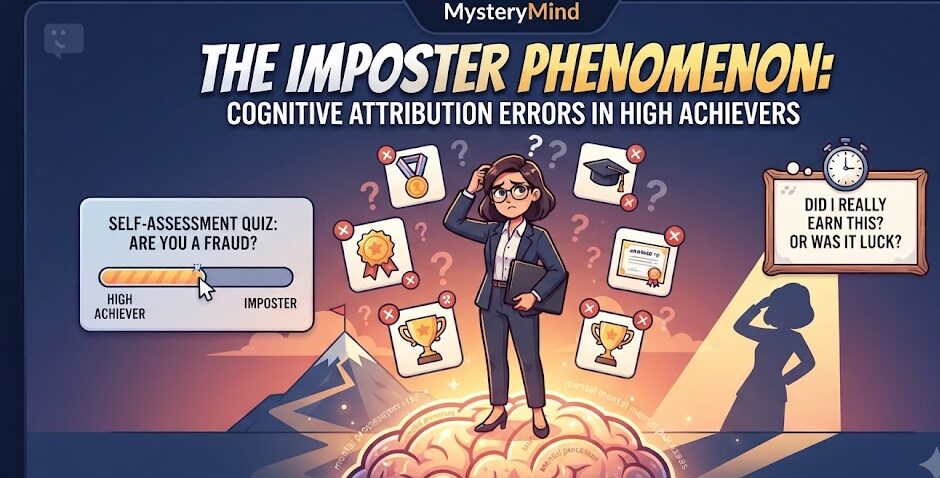
1. Theoretical and Clinical Foundations: Pauline Clance’s Discovery
In 1978, clinical psychologists Pauline Rose Clance and Suzanne Imes published a groundbreaking diagnostic study in Psychotherapy: Theory, Research & Practice identifying a pervasive, agonizing psychological condition among exceptionally accomplished women: The Imposter Phenomenon (IP).
Defined as an internal psychological experience of intellectual phoniness, fraudulence, and unworthiness despite outstanding, verified objective achievements, the imposter phenomenon is characterized by an individual’s chronic inability to internalize their own success. Rather than experiencing legitimate pride in their academic degrees, patents, corporate promotions, or clinical milestones, individuals suffering from the imposter phenomenon live in perpetual dread of being exposed as an incompetent fraud.
Crucially, Clance and subsequent researchers established that the imposter phenomenon is not a formal psychiatric personality disorder (DSM-5); it is a widespread cognitive-affective syndrome that disproportionately strikes high achievers, researchers, physicians, software architects, and creative pioneers. An estimated 70% of high-functioning adults experience severe imposter episodes at least once in their careers.
Deconstructing the neuropsychological architecture of the imposter phenomenon reveals that it is fundamentally driven by a severe, systemic cognitive distortion: Asymmetrical Causal Attribution, sustained by hyper-active self-referential default-mode circuits and perfectionistic neuroendocrine feedback loops.
2. The Core Cognitive Distortion: Asymmetrical Causal Attribution
At the heart of the imposter phenomenon lies an inverted attributional style that violates normal psychological self-defense:
Healthy Attributional Style (The Self-Serving Bias): In healthy, well-adjusted individuals, the brain naturally protects self-esteem through a standard attributional filter:
• When I succeed, it is due to internal, stable factors: “I am smart, skilled, and worked hard.”
• When I fail, it is due to external, unstable factors: “The test was unfair; bad timing; bad luck.”
The Imposter Inversion (Pathological Discounting): In high achievers with the imposter phenomenon, this filter is flipped into an agonizing, self-punishing asymmetry:
• When I succeed, it is attributed entirely to external, transient coincidences: “I got lucky; they made a clerical error; someone felt sorry for me; I charmed the interviewers; anyone could have done it.”
• When I fail or make a minor mistake, it is attributed entirely to internal, permanent unworthiness: “This proves I am fundamentally incompetent, stupid, and an intellectual fraud.”
Because all successes are discarded as flukes, no amount of real-world evidence—whether a PhD, a Nobel prize, or a multi-million-dollar exit—can ever penetrate the cognitive shield. The evidence is simply dismissed as “proof that I fooled them again,” creating a tragic feedback loop where escalating objective success actually amplifies the terror of exposure!
3. The Clance Imposter Cycle: Over-Preparation vs Procrastination
Pauline Clance mapped the behavioral trap that perpetuates the syndrome into an explicit, recurring closed loop: The Imposter Cycle:
1. The High-Stakes Task Assignment: A major challenge is assigned (e.g., presenting to the board of directors or leading a surgical team).
2. Acute Anxiety and Dread: The prospect of public evaluation triggers intense amygdala distress and fear of exposure.
3. The Dual Behavioral Divergence:
• Path A: Frenzied Over-Preparation: The individual engages in compulsive, manic over-work—sleeping 3 hours a night, reviewing slides 50 times, reading 100 superfluous papers.
• Path B: Chronic Defensive Procrastination: The individual freezes in paralysis until the final 24 hours, followed by a desperate panic-fueled sprint to finish.
4. Objective Success and External Praise: The project is executed successfully; supervisors and peers applaud the outcome.
5. False Reinforcement and Cycle Renewal: Instead of feeling satisfaction, the imposter discounts the victory:
• If they over-prepared: “I only succeeded because I worked myself to the bone; if I were genuinely smart, it would have been effortless.”
• If they procrastinated: “I fooled them at the last minute; next time my luck will run out.”
The cycle resets, with the baseline terror higher for the next challenge.
4. Neuroanatomical Circuits: Default Mode Network Rumination and Error Hyper-Vigilance
Functional neuroimaging (fMRI) and event-related potential (ERP) electrophysiology have mapped the distinct neural correlates of imposter vulnerability:
Default Mode Network (DMN) Hyper-Connectivity: The DMN (medial prefrontal cortex, posterior cingulate cortex, and precuneus) mediates self-referential mental simulation and autobiographical memory. In individuals suffering from the imposter phenomenon, the DMN exhibits persistent hyper-connectivity with the amygdala, creating a runaway rumination engine that constantly replays past social embarrassments and catastrophizes future exposure scenarios.
Hyper-Sensitized Error-Related Negativity (ERN): High-density EEG reveals that imposter individuals exhibit abnormally high Error-Related Negativity (ERN) waveforms over the dorsal anterior cingulate cortex within 80 milliseconds of committing an error. While healthy high-achievers treat minor errors as neutral feedback, imposter brains experience a minor typo or imperfect slide as an existential crisis—a visceral threat to survival.
Blunted Striatal Dopamine Reward Feedback: In healthy individuals, completing a grueling task triggers a robust burst of dopamine in the nucleus accumbens, producing feelings of pride and satisfaction. In imposter individuals, fMRI shows blunted striatal reward signals post-success; the relief is merely the temporary absence of disaster (“I survived this time”), which quickly decays back into baseline anxiety.
5. Clinical Intervention Protocols: Rewriting the Internal Attribution Script
Overcoming the imposter phenomenon is not about boosting superficial self-esteem; it is about rigorous, neurocognitive de-biasing:
1. The “Fact vs Feeling” Decoupling: Imposters commit the emotional reasoning fallacy: “I feel like a fraud, therefore I must be a fraud.” Clinical neuropsychology teaches patients to recognize that feelings are transient neurochemical states in the insula and amygdala, not objective forensic facts. Feeling like a fraud is simply an evolutionary byproduct of pushing yourself outside your comfort zone into high-complexity environments.
2. The Imposter Paradox: True incompetents never experience the imposter phenomenon! As the Dunning-Kruger effect proves, truly unqualified, incompetent individuals possess overwhelming, unjustified confidence because they lack the intelligence to see their own shortcomings. The very fact that you feel like an imposter is empirical proof that you are self-aware, intelligent, and understand the depth of your domain.
Comparative Neuroanalytical Framework
To quantify the physiological, metabolic, and behavioral divergence across attentional states, the following high-density comparative matrix contrasts baseline operations against acute focus trajectories:
Actionable Clinical & Cognitive Protocols
Translating neurobiological theory into measurable intellectual performance requires standardized behavioral frameworks designed to optimize synaptic signaling and preserve metabolic substrates:
Protocol 1: The Hard-Evidence Forensic Success Dossier
Because the imposter brain suffers from selective amnesia regarding successes, build an objective Forensic Evidence Dossier: create a physical binder or dedicated encrypted digital folder containing cold, verifiable artifacts of your competence—published peer-reviewed papers, client performance metrics, promotion letters, patent approvals, and unsolicited written praise. When imposter feelings strike, force your eyes to review the physical forensic proof.
Protocol 2: The Symmetrical Attribution Audit
Whenever you achieve a major milestone and catch your brain whispering “I just got lucky,” enforce a mandatory attribution exercise: Write down the Top 3 specific, controllable skills, decisions, and sacrifices you made that directly caused the outcome (e.g., “1. I spent 40 hours building the prototype; 2. I refactored the database architecture; 3. I gave a crisp presentation”). Forcing internal attribution trains the striatum to register self-efficacy.
Protocol 3: The 85% “Good-Enough” Exposure Sprint
Break the frenzied over-preparation trap through behavioral exposure therapy: deliberately submit an internal memo, code commit, or presentation that is completed to 85% perfection rather than 100%. Resist the urge to do the 5th polish. You will discover that the sky does not fall, nobody accuses you of fraud, and the feedback is overwhelmingly positive. This desensitizes the anterior cingulate ERN alarm.
Protocol 4: Radical Transparency with Trusted Peer Mentors
The imposter phenomenon thrives in secrecy and isolation. The moment you verbally confess your feeling of phoniness to an esteemed, senior colleague or mentor, they almost universally respond: “I feel the exact same way every single day.” De-sanctifying the expertise of others destroys the toxic comparison trap and normalizes self-doubt as the universal companion of ambitious intellectual growth.
Common Neuromyths, Pitfalls & Diagnostic Misattributions
- Believing That Another Degree Will Fix It: Thinking: “Once I get my Master’s / PhD / promotion, I will finally feel competent.” Credentials never fix attributional distortions; they simply raise the stakes of your imagined exposure. The fix must be internal cognitive restructuring.
- Equating Natural Talent with Effortless Mastery: Believing the toxic myth that if you were truly brilliant, things would come effortlessly without struggle. Every world-class neurosurgeon, concert pianist, and mathematician struggles intensely through difficult material. Struggle is how the brain learns, not proof of stupidity.
- Confusing Humility with Self-Erasure: Believing that owning your accomplishments makes you arrogant. True humility is accurate self-assessment—neither exaggerating nor diminishing your real skills. Erasing your legitimate accomplishments is false modesty and cognitive self-sabotage.
- Chronic Over-Working as a Safety Shield: Burning out your health and relationships by working 80-hour weeks to compensate for imagined unworthiness. Over-work is a maladaptive defense mechanism that destroys executive cognitive function over time.
Frequently Asked Clinical Questions (FAQ)
Is the Imposter Phenomenon an official mental illness in the DSM-5?
No. The Imposter Phenomenon is not classified as a psychiatric illness or personality disorder in the DSM-5 or ICD-11. It is a recognized cognitive-affective pattern that occurs in psychologically healthy, highly functional individuals. However, if left unaddressed, chronic imposter feelings can trigger clinical depression, generalized anxiety disorder, and severe professional burnout.
Why does the imposter phenomenon affect high achievers more than underachievers?
High achievers operate at the bleeding edge of their disciplines, surrounded by brilliant peers and tackling complex, ambiguous problems with no simple answers. Because they have high metacognitive awareness, they acutely perceive the vast expanse of what they do not yet know. In contrast, underachievers suffer from the Dunning-Kruger effect, remaining blissfully ignorant of their deficiencies.
Did Albert Einstein suffer from the imposter phenomenon?
Yes. Near the end of his life, Albert Einstein confided to a close friend: ‘The exaggerated esteem in which my lifework is held makes me very ill at ease. I feel compelled to think of myself as an involuntary swindler.’ If the greatest physicist in modern history felt like a swindler, it proves that imposter feelings are about cognitive attribution, not actual incompetence.
How does the imposter phenomenon differ between men and women?
While early studies in the 1970s focused on women, modern research shows that men and women experience imposter feelings at roughly equal rates. However, their coping mechanisms often differ: men are more likely to mask their feelings through defensive bravado or avoidance, while women more frequently internalize anxiety and engage in frenzied over-preparation.
Can the imposter phenomenon ever be completely eliminated?
Rather than trying to eradicate it completely, elite performers reframe the feeling. When imposter anxiety arises, they interpret it not as a signal of unworthiness, but as a thrilling notification: ‘I have stepped into an arena that is challenging enough to stretch my abilities.’ Reframing self-doubt as a companion of growth disarms its paralyzing power.
Peer-Reviewed Scholarly References
- Clance, P. R., & Imes, S. A. (1978). The imposter phenomenon in high achieving women: Dynamics and therapeutic intervention. Psychotherapy: Theory, Research & Practice, 15(3), 241-247.
- Harvey, J. C., & Katz, C. (1985). If I’m So Successful, Why Do I Feel Like a Fake? The Impostor Phenomenon. St. Martin’s Press.
- Kruger, J., & Dunning, D. (1999). Unskilled and unaware of it: How difficulties in recognizing one’s own incompetence lead to inflated self-assessments. Journal of Personality and Social Psychology, 77(6), 1121-1134.
- Sakulku, J., & Alexander, J. (2011). The impostor phenomenon. International Journal of Behavioral Science, 6(1), 75-97.
- Bravata, D. M., et al. (2020). Prevalence, predictors, and treatment of impostor syndrome: a systematic review. Journal of General Internal Medicine, 35(4), 1252-1275.
- Weiner, B. (1985). An attributional theory of achievement motivation and emotion. Psychological Review, 92(4), 548-573.
- Neureiter, M., & Traut-Mattausch, E. (2016). Inspecting the dangers of feeling like a fake: An empirical investigation of the impostor phenomenon in the career context. Frontiers in Psychology, 7, 1445.