1. Theoretical Foundations: The Architecture of Human Working Memory
Working memory (WM) constitutes the central cognitive workbench of the human mind. Defined as the neurobiological capacity to simultaneously hold, update, and manipulate information across transient delay periods, working memory differs fundamentally from passive short-term memory storage. While short-term storage merely retains an unmanipulated sequence of digits or phonemes, working memory executes complex algorithmic operations upon those representations while actively resisting retroactive and proactive cognitive interference.
According to Alan Baddeley’s classic tripartite model, working memory comprises four coordinated structural sub-components: the Central Executive (the attentional conductor allocating focus and inhibiting intrusions), the Phonological Loop (subvocal auditory rehearsal buffer), the Visuospatial Sketchpad (visual imagery and spatial coordinate buffer), and the Episodic Buffer (a multidimensional integrator binding cross-modal streams into coherent conscious episodes).
For decades, mainstream cognitive science held that human working memory capacity was biologically fixed and strictly limited to roughly four independent information chunks (Cowan’s K). However, the landmark 2008 publication by Susanne Jaeggi and colleagues upended this dogma by demonstrating that intensive, adaptive training on a cross-modal paradigm known as the Dual N-Back Task could expand working memory capacity and produce statistically meaningful transfer to generalized fluid intelligence (Gf).
Understanding the neurocomputational mechanics of Dual N-Back training requires deconstructing how synchronous multi-sensory interference challenges prefrontal pyramidal circuits, forces synaptic remodeling, and enhances the signal-to-noise ratio within frontoparietal attention networks.
2. Mechanics of the Dual N-Back Paradigm
The Dual N-Back task is intentionally engineered to overwhelm sensory buffers and deny the participant access to automated heuristics or passive rehearsal strategies:
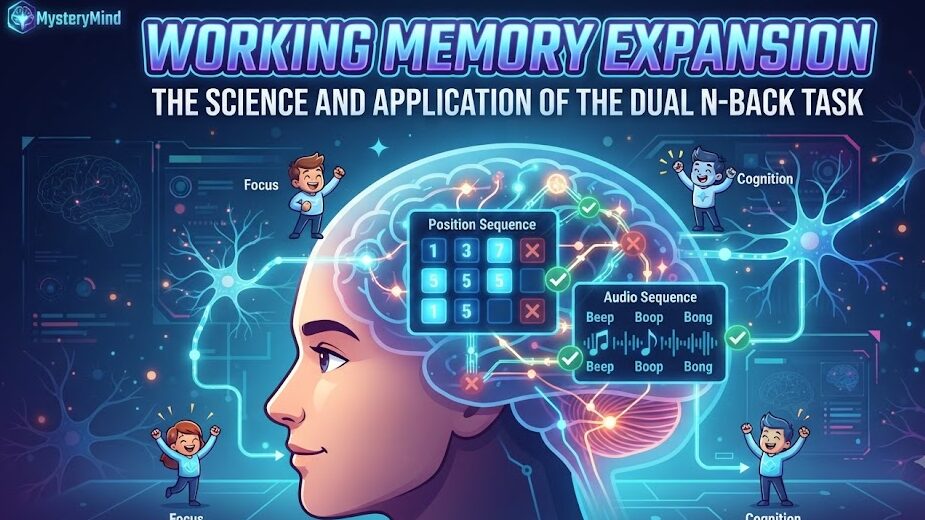
Synchronous Bimodal Stimulation: In each trial, the participant is simultaneously presented with two distinct sensory stimuli: a visual stimulus (a square flashing within one cell of a 3×3 grid) and an auditory stimulus (a spoken consonant letter played through headphones). The presentation lasts approximately 500 milliseconds, followed by a 2500 millisecond inter-stimulus decision window.
The “N” Lag Comparison: The participant’s objective is to indicate whether the current visual position matches the position presented exactly N trials prior, AND simultaneously indicate whether the current spoken letter matches the letter spoken exactly N trials prior. In 1-back, the participant compares the current trial to the immediate predecessor. In 2-back, the comparison is to two steps prior; in 3-back, three steps prior, and so forth.
Dynamic Updating and Continuous Discarding: The cognitive brilliance of the paradigm lies in its continuous temporal updating requirement. To succeed at 3-back, the brain must hold trials [N-3, N-2, N-1] in active consciousness. When trial [N] arrives, the participant must evaluate the match, purge trial [N-3] from memory, slide trials [N-2] and [N-1] backward into positions [N-3] and [N-2], and encode trial [N] into position [N-1]. This continuous sliding-window operation prevents the formation of static mnemonic anchors and demands ruthless executive inhibitory gating.
Adaptive Difficulty Thresholds: The task automatically scales its difficulty based on real-time performance. If an individual achieves greater than 80% accuracy across a 20-trial block, N increases by 1 for the subsequent block. If accuracy drops below 50%, N decreases. This keeps the participant perpetually suspended at the very edge of cognitive capacity—the precise physiological zone required to trigger structural neuroplasticity.
3. Neuroimaging Findings: Frontoparietal Blood Oxygenation and Synaptic Remodeling
Functional neuroimaging (fMRI) and functional near-infrared spectroscopy (fNIRS) during longitudinal Dual N-Back regimens have elucidated the neural mechanisms underlying training-induced cognitive adaptations:
Bilateral Dorsolateral Prefrontal Activation: Naive participants performing Dual N-Back exhibit disorganized, diffuse bilateral prefrontal blood oxygen level-dependent (BOLD) signals. However, following 4 to 6 weeks of daily training, fMRI scans show a biphasic neural evolution: initially, dlPFC activation surges dramatically as the brain recruits auxiliary cortical territory to handle the cognitive load. Subsequently, as behavioral competence stabilizes, dlPFC activation becomes highly focal and metabolically efficient, firing with sharp temporal precision only during the critical match-verification phase.
Posterior Parietal and Intraparietal Sulcus (IPS) Reorganization: The IPS is responsible for tracking visual spatial coordinates across the grid, while the superior parietal lobule coordinates spatial attention. Training systematically enhances functional connectivity between the left inferior frontal gyrus (broca’s area, supporting phonological rehearsal) and the bilateral IPS, creating a high-speed neural bridge between auditory and spatial cortical buffers.
Structural White Matter Integrity: Diffusion Tensor Imaging (DTI) investigations reveal that sustained Dual N-Back practice increases fractional anisotropy (a direct measure of white matter organization and myelination) along the superior longitudinal fasciculus (SLF). The SLF is the primary anatomical superhighway connecting prefrontal executive modules to parietal sensory processors; its structural reinforcement explains why working memory gains can translate into generalized processing speed enhancements.
4. Neurochemical Mechanics: Dopamine D1 Receptor Binding and Prefrontal Plasticity
The behavioral improvements elicited by Dual N-Back training are fundamentally underpinned by micro-neurochemical adjustments within the striatum and prefrontal cortex:
Modulation of Cortical Dopamine D1 Receptors: Landmark positron emission tomography (PET) research conducted by McNab and colleagues demonstrated that intensive working memory training directly alters cortical dopamine D1 receptor binding potential. The D1 receptor is paramount for stabilizing neural representations in the dlPFC against background noise. By forcing persistent recurrent excitation among prefrontal pyramidal neurons, Dual N-Back training upregulates D1 receptor density, creating a robust neurochemical shield that protects working memory items from decay and emotional distraction.
Upregulation of Striatal D2 Autoreceptors: While prefrontal D1 receptors provide stability, striatal dopamine D2 receptors regulate cognitive flexibility and executive gating. Training enhances striatal gating efficiency, allowing the basal ganglia to instantaneously open the gate for relevant incoming sensory stimuli while slamming the gate shut against irrelevant environmental interference.
Glutamate/GABA Ratio Optimization: Magnetic resonance spectroscopy (MRS) reveals that working memory training balances prefrontal excitation and inhibition. Glutamatergic recurrent circuits are strengthened via long-term potentiation (LTP), while local parvalbumin-positive GABAergic interneurons are tuned to provide sharp perisomatic inhibition, sharpening the boundaries between competing memory representations.
5. The Far-Transfer Controversy: Analyzing Empirical Replication Debates
The scientific discourse surrounding Dual N-Back is intensely polarized regarding the distinction between near transfer and far transfer:
Near Transfer (Universally Replicated): Near transfer refers to performance improvements on untrained tasks that rely on the exact same cognitive construct—namely, other working memory benchmarks. Across dozens of rigorous meta-analyses, Dual N-Back training reliably produces robust, statistically significant near transfer: participants demonstrate superior operation span (O-Span), reading span, backward digit recall, and visual matrix memory.
Far Transfer (The Gf Transfer Debate): Far transfer occurs when training on working memory improves performance on fundamentally distinct cognitive domains, specifically non-verbal fluid intelligence (e.g., Raven’s Matrices) or academic standardized reasoning. While Jaeggi (2008, 2011) and several subsequent neuroimaging cohorts demonstrated significant Gf improvements, critical meta-analyses (such as Melby-Lervåg & Hulme, 2013; Shipstead et al., 2012) argued that far-transfer effect sizes attenuate when compared against active, motivated control groups rather than passive waitlists.
Resolving the Paradox: The Latent Capacity Hypothesis: Modern cognitive neuroscience resolves this debate through the “Latent Capacity Model.” Dual N-Back does not magically alter an individual’s innate genetic IQ limit; rather, it eliminates the attentional bottlenecks and working memory leakage that prevent individuals from realizing their full latent fluid intelligence. By expanding active buffer capacity from 3 items to 5 items, an individual can now simultaneously compare all moving parts of a complex deductive logic problem without losing track of earlier premises.
Comparative Neuroanalytical Framework
To quantify the physiological, metabolic, and behavioral divergence across attentional states, the following high-density comparative matrix contrasts baseline operations against acute focus trajectories:
Actionable Clinical & Cognitive Protocols
Translating neurobiological theory into measurable intellectual performance requires standardized behavioral frameworks designed to optimize synaptic signaling and preserve metabolic substrates:
Protocol 1: The Jaeggi Dose-Response Regimen (20-Minute Protocol)
Execute exactly 20 blocks per day (approximately 20 to 25 minutes total training duration), 5 days per week, for a minimum continuous duration of 4 to 6 weeks. Each block consists of 20+N trials. Research demonstrates that training sessions shorter than 15 minutes fail to trigger prefrontal synaptic remodeling, while sessions exceeding 35 minutes induce cognitive exhaustion that triggers erratic performance collapse.
Protocol 2: Strict Ban on Compensatory Mnemonic Strategies
To force pure neuroplastic adaptation of the frontoparietal central executive, strictly avoid external or artificial mnemonic cheats: do not create spatial physical finger taps, do not chant letter-pairs aloud, and do not construct artificial narrative stories. Rely entirely on internal working memory buffers. Developing artificial heuristics defeats the purpose of the exercise and abolishes far transfer.
Protocol 3: Post-Training Cholinergic & Glymphatic Consolidation
Working memory training induces significant structural demands on synaptic spines. Consuming dietary choline precursors (alpha-GPC or citicoline) 45 minutes prior to training optimizes central acetylcholine release. Follow each daily training session with adequate hydration and ensure 7.5 to 8.5 hours of nocturnal slow-wave sleep to allow the glymphatic system to clear metabolic byproducts and consolidate synaptic protein synthesis.
Protocol 4: Progression to Tri-Back and Quad-Back Variations
Once a consistent 4-back or 5-back performance is sustained across three consecutive weeks, introduce higher-dimensional interference by adding a third sensory dimension (e.g., color tint of the square or auditory pitch variation). This “Tri-Back” configuration recruits the frontopolar prefrontal cortex (Brodmann Area 10), training high-order branch management and multi-tasking executive integration.
Common Neuromyths, Pitfalls & Diagnostic Misattributions
- The “Button-Mashing Guessing” Trap: When reaching difficult N levels (such as 3-back or 4-back), untrained participants often guess impulsively when uncertainty strikes. Guessing contaminates the adaptive algorithm, artificially inflating your N-level beyond actual capability and causing severe frustration and neural fatigue.
- Training in Fragmented, Distracted Environments: Dual N-Back requires 100% focused cognitive immersion. Training while listening to background podcasts, having notifications active, or sitting in a noisy room fragments the central executive and renders the task biologically ineffective.
- Overtraining Past Cognitive Diminishing Returns: Training for 2 hours in a single day produces acute prefrontal glycogen depletion and increases adenosine accumulation, degrading synaptic plasticity. Consistency over 30 consecutive days is dramatically superior to sporadic multi-hour marathons.
- Assuming Dual N-Back Replaces Real-World Domain Practice: Expanding working memory provides an enhanced mental workspace, but it does not automatically deposit domain expertise. Dual N-Back expands the computational RAM of the brain; you must still deliberately study mathematics, coding, or writing to build the crystallized software.
Frequently Asked Clinical Questions (FAQ)
How long does it typically take to advance from Dual 2-Back to Dual 3-Back?
Most cognitively intact adults require between 7 and 14 consecutive daily sessions (20 minutes each) to transition reliably from 2-back to 3-back. The jump from 2-back to 3-back represents the steepest hurdle in the paradigm, as it exceeds the typical passive capacity of Cowan’s working memory buffer (which naturally caps at 3 items without executive chunking).
Does Dual N-Back training help individuals with ADHD or executive dysfunction?
Yes. Numerous clinical trials demonstrate that individuals with ADHD or sub-clinical attentional deficits show pronounced benefits from Dual N-Back training. Because ADHD is characterized by prefrontal dopamine dysregulation and poor inhibitory gating, the forced engagement of dlPFC circuits and striatal dopamine systems directly targets the underlying pathophysiological deficits, resulting in measurable reductions in distractibility.
What is the difference between Position N-Back and Dual N-Back?
Position N-Back tests only visual spatial coordinates (single modality). It can be easily mastered through visual trace memory without engaging cross-modal executive control. Dual N-Back forces simultaneous visual-spatial and auditory-phonological comparison, requiring continuous coordination by the frontoparietal central executive and producing vastly superior neuroplastic remodeling.
Do working memory improvements persist after you stop training?
Longitudinal follow-up studies (such as Jaeggi et al., 2014) indicate that working memory and fluid transfer gains persist for at least 3 to 6 months post-training without further intervention. However, like cardiovascular fitness, working memory capacity exhibits biological regression if unused over multi-year horizons. A maintenance regimen of 1–2 sessions per week is recommended to preserve peak frontoparietal density.
Why is Dual N-Back so mentally exhausting compared to other brain games?
Unlike commercial matching games or crossword puzzles that rely on passive familiarity or crystallized semantic recall, Dual N-Back actively prohibits the use of automated heuristics. Every single millisecond demands maximal active prefrontal glucose consumption, continuous inhibitory suppression of previous stimuli, and intense synaptic updating, leading to rapid accumulation of extracellular adenosine in the dlPFC.
Peer-Reviewed Scholarly References
- Jaeggi, S. M., Buschkuehl, M., Jonides, J., & Perrig, W. J. (2008). Improving fluid intelligence with training on working memory. PNAS, 105(19), 6829-6833.
- Baddeley, A. (2003). Working memory: looking back and looking forward. Nature Reviews Neuroscience, 4(10), 829-839.
- McNab, F., et al. (2009). Changes in cortical dopamine D1 receptor binding associated with cognitive training. Science, 323(5915), 800-802.
- Cowan, N. (2001). The magical number 4 in short-term memory: A reconsideration of mental storage capacity. Behavioral and Brain Sciences, 24(1), 87-114.
- Olesen, P. J., Westerberg, H., & Klingberg, T. (2004). Increased prefrontal and parietal activity after training of working memory. Nature Neuroscience, 7(1), 75-79.
- Au, J., et al. (2015). Improving fluid intelligence with dual n-back working memory training: a meta-analysis. Psychonomic Bulletin & Review, 22(2), 366-377.
- Shipstead, Z., Redick, T. S., & Engle, R. W. (2012). Is working memory training effective? Psychological Bulletin, 138(4), 628-654.