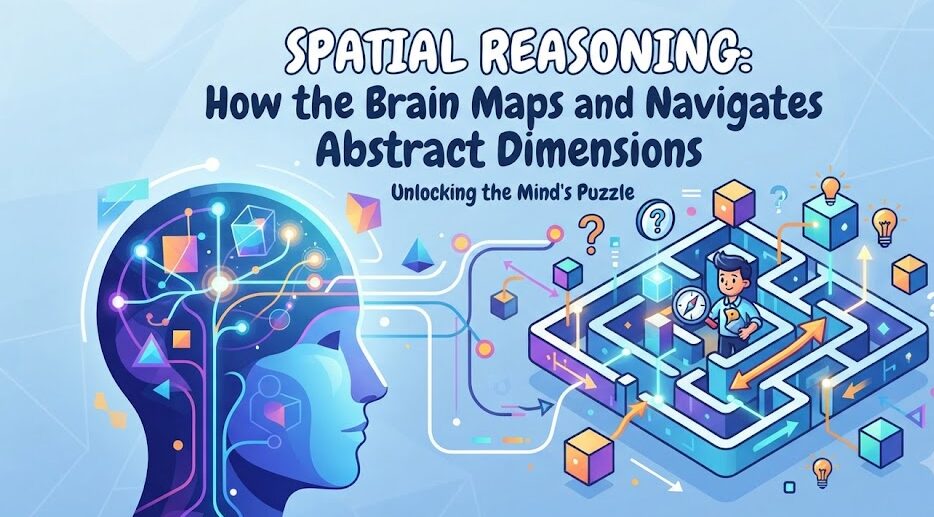
1. Theoretical Foundations: The Evolutionary Primacy of Spatial Cognition
Spatial reasoning—the cognitive ability to perceive, manipulate, mentally transform, and navigate multidimensional geometric and topographic relationships—represents one of the oldest evolutionary adaptations in the vertebrate nervous system. Long before hominids developed syntactic language, symbolic mathematics, or formal philosophical logic, survival hinged entirely upon an organism’s capacity to navigate complex physical topographies, calculate ballistic trajectories, map predator territories, and mentally simulate tool creation.
In contemporary cognitive science, spatial ability is no longer viewed merely as an isolated aptitude for geometry or mechanical drafting. Groundbreaking research in cognitive linguistics and computational neuroscience confirms that human abstract thinking is fundamentally built upon the scaffolding of spatial reasoning. When we conceptualize time (“looking forward to the future”), organize hierarchical social structures (“climbing the organizational ladder”), or balance abstract mathematical equations, our brains recycle ancient neural machinery originally evolved for physical navigation and object manipulation.
Psychometrically, spatial cognition comprises several distinct sub-factors: mental rotation (the capacity to rotate two- and three-dimensional objects in the mind’s eye), spatial visualization (multi-step transformations of folded or deconstructed shapes), spatial perception (determining spatial orientations relative to one’s own body posture), and mental navigation (path integration and cognitive mapping). Deconstructing the neurobiology behind these capabilities illuminates why spatial competence serves as the single strongest statistical predictor of long-term success in STEM (Science, Technology, Engineering, and Mathematics) disciplines.
2. Neuroanatomical Substrates: The Dorsal “Where” Stream and Parietal Cortex
Visual information arriving from the primary visual cortex (V1/Brodmann Area 17) segregates into two massive parallel processing pathways: the ventral “what” stream (projecting to the inferior temporal cortex for object identification) and the dorsal “where/how” stream (projecting to the posterior parietal cortex for spatial processing and motor action guidance):
The Superior Parietal Lobule (SPL): Localized within Brodmann Area 7, the SPL is the core engine of 3D mental rotation and spatial coordinate transformation. Neuroimaging studies utilizing Shepard and Metzler mental rotation tasks reveal that SPL activation scales linearly with the degree of angular disparity between two objects. When an individual mentally rotates a 3D block figure by 120 degrees versus 40 degrees, the duration and metabolic intensity of SPL BOLD firing increase proportionally, demonstrating that mental rotation is an analog, continuous neurocomputational simulation rather than an instantaneous symbolic deduction.
The Intraparietal Sulcus (IPS): The IPS acts as an executive spatial register, translating egocentric coordinates (locations relative to the observer’s eye and hand positions) into allocentric coordinates (locations relative to external landmarks and independent geometric frameworks). Furthermore, the anterior portion of the IPS coordinates cross-modal spatial integration, seamlessly binding visual spatial maps with somatosensory and vestibular inputs.
The Frontoparietal Attentional Network: Mental spatial manipulation requires holding an object’s structural topology in working memory while systematically applying vector transformations. This requires continuous bidirectional communication between the posterior parietal cortex and the caudal prefrontal cortex (frontal eye fields and pre-motor cortex), ensuring that the mental representation does not decay mid-rotation.
3. The Hippocampal-Entorhinal GPS: Place Cells, Grid Cells, and Vector Coding
While the parietal cortex executes short-term spatial transformations, large-scale topographic navigation and abstract cognitive mapping are mediated by the Nobel-prize-winning discovery of the hippocampal-entorhinal navigational system:
Place Cells of the Hippocampus: Discovered by John O’Keefe, place cells located in the CA1 and CA3 pyramidal layers of the hippocampus fire selectively when an organism occupies a specific physical location in an environment (its “place field”). Collectively, populations of place cells construct dynamic, context-specific cognitive maps of explored terrain.
Grid Cells of the Medial Entorhinal Cortex (MEC): Discovered by Edvard and May-Britt Moser, grid cells fire at regular, periodic spatial intervals, forming a stunning hexagonal, crystalline coordinate mesh that carpets the entire known environment. Unlike place cells, which are tied to specific sensory landmarks, grid cells provide an intrinsic, metric Euclidean coordinate system that calculates distance, velocity, and direction—enabling flawless dead reckoning (path integration).
Head-Direction Cells and Border Cells: Complementing grid cells, head-direction cells (firing like an internal compass based on vestibular inputs) and border cells (firing when nearing a physical boundary) feed directly into the entorhinal grid, providing an orientation framework that anchors the cognitive map.
The “Cognitive Map” Hypothesis for Abstract Concepts: Astonishingly, recent fMRI studies (such as Constantinescu et al., 2016) reveal that when humans navigate abstract conceptual spaces—such as evaluating birds categorized by neck length and leg length, or navigating organizational hierarchies—the medial entorhinal cortex exhibits the exact same hexagonal grid-like firing pattern! The human brain literally repurposes its physical navigation hardware to chart multidimensional abstract concepts.
4. Cognitive Transfer: Spatial Reasoning as the Engine of STEM Competence
Longitudinal educational and neuropsychological cohorts (such as Project TALENT, tracking over 400,000 students across 50 years) have demonstrated that spatial reasoning ability in adolescence is the single most potent predictor of adult attainment in STEM disciplines, including quantum physics, mechanical engineering, surgical proficiency, and software architecture—even after strictly controlling for verbal and mathematical IQ scores:
Molecular Chemistry and Biochemistry: Conceptualizing protein folding, enzyme-substrate lock-and-key interactions, and stereochemical enantiomers requires continuous mental rotation of complex three-dimensional molecular structures.
Surgical and Endoscopic Proficiency: Minimally invasive laparoscopic and robotic surgery forces the physician to manipulate instruments across a two-dimensional monitor while mentally translating those vectors into a patient’s three-dimensional anatomical cavity—a pure manifestation of allocentric-to-egocentric coordinate conversion.
Software and Computer Systems Architecture: Advanced software engineering is inherently non-linear and topological. Visualizing distributed microservice architectures, database relational schemas, and data flow pipelines relies directly on frontoparietal spatial-symbolic mapping circuits.
5. Neuroplasticity and Spatial Training: Remodeling the Parieto-Hippocampal Axis
Contrary to outdated theories claiming spatial reasoning is biologically fixed, modern structural MRI demonstrates that spatial circuits possess remarkable neuroplastic malleability:
The London Taxi Driver Landmark Finding: Eleanor Maguire’s legendary structural MRI studies of licensed London taxi drivers revealed that navigating “The Knowledge” (memorizing 25,000 streets and thousands of landmarks) produced profound, statistically significant increases in gray matter volume in the posterior hippocampus. Crucially, the volume expansion correlated directly with the number of years spent driving, demonstrating activity-dependent neurogenesis and dendritic arborization.
Mental Rotation Training and Cortical Thickening: Engaging in progressive spatial visualization tasks (such as origami engineering, CAD modeling, and 3D mental rotation exercises) for 12 weeks leads to measurable cortical thickening in the intraparietal sulcus and increased fractional anisotropy in the superior longitudinal fasciculus, establishing that deliberate spatial training reconstructs cortical architecture.
Comparative Neuroanalytical Framework
To quantify the physiological, metabolic, and behavioral divergence across attentional states, the following high-density comparative matrix contrasts baseline operations against acute focus trajectories:
Actionable Clinical & Cognitive Protocols
Translating neurobiological theory into measurable intellectual performance requires standardized behavioral frameworks designed to optimize synaptic signaling and preserve metabolic substrates:
Protocol 1: Progressive 3D Mental Rotation Drills
Engage in 15 minutes of structured Shepard-Metzler mental rotation challenges 3 times per week. Begin with 2D planar rotations, progressing to complex 10-cube isometric polyominoes rotated across 3 axes. Focus on maintaining the structural invariance of the object without verbalizing labels, forcing pure parietal-occipital vector computation.
Protocol 2: Deliberate GPS Weaning & Allocentric Dead Reckoning
Modern reliance on turn-by-turn GPS turn prompts induces functional atrophy of the hippocampus and entorhinal cortex. Once per week, navigate unfamiliar urban or natural environments using only a static topological map reviewed prior to departure. Continuously maintain an internal representation of cardinal directions and your position relative to fixed landmarks.
Protocol 3: Cross-Sectional Geometry & CAD Visualization
Practice mental slicing of three-dimensional solids. Visualize an oblique plane intersecting a hollow cylinder or a complex torus, and accurately predict the 2D cross-sectional geometry that results. This exercise stimulates the anterior intraparietal sulcus and strengthens spatial visualization bandwidth.
Protocol 4: Spatial Gesture Coupling During Abstract Communication
When deconstructing abstract problems or explaining complex concepts, deliberately utilize iconic and metaphoric hand gestures. Neuroimaging demonstrates that physical gesturing activates the premotor cortex and parietal networks, offloading cognitive burden from verbal working memory into motor-spatial buffers and enhancing problem-solving velocity.
Common Neuromyths, Pitfalls & Diagnostic Misattributions
- The “Verbalization Crutch” in Mental Rotation: Untrained individuals frequently try to solve spatial puzzles by attaching verbal labels to features (e.g., “the blue block is at the top right”). This verbal strategy is sluggish, overloads the phonological loop, and breaks down completely when 3D angles are non-orthogonal. True spatial rotation must be performed visually and kinesthetically.
- Neglect of Spatial Training in Traditional Education: Modern academic curricula focus overwhelmingly on verbal linguistics and symbolic algorithmic calculation, largely abandoning formal spatial visualization instruction. This creates a severe developmental deficit for students aspiring to careers in high-level engineering and experimental sciences.
- Over-reliance on Digital 3D Renders: Passively watching a CAD software automatically rotate a 3D model on a screen produces near-zero parietal activation. The neuroplastic benefit occurs exclusively during the effortful internal mental simulation where your own parietal circuits compute the vector transformation.
- Assuming Spatial Competence Is Innate and Unchangeable: While baseline spatial ability displays significant genetic variance, spatial reasoning shows some of the largest effect-size gains of any cognitive domain when targeted with deliberate, progressive spatial practice.
Frequently Asked Clinical Questions (FAQ)
Why is spatial reasoning such a strong predictor of engineering and surgical aptitude?
Engineering and surgery require manipulating systems that cannot be reduced to simple verbal formulas. An engineer must visualize how mechanical shear stress distributes across a 3D truss, while a surgeon must anticipate how retracting an organ exposes underlying vascular trees. These tasks rely on real-time allocentric coordinate transformation and mental simulation in the posterior parietal cortex.
Are there sex differences in spatial reasoning, and what does neuroscience say?
Mental rotation tasks consistently demonstrate one of the largest observed sex differences in cognitive testing, favoring males on average (effect size d ≈ 0.6 to 0.8). Neuroimaging reveals differences in processing strategy: males tend to recruit right parietal and motor areas for holistic analog rotation, whereas females more frequently recruit bilateral frontal areas for analytical feature-matching. However, targeted spatial training eliminates the vast majority of this performance gap within weeks.
How does GPS navigation affect the hippocampus?
Longitudinal studies demonstrate that habitual reliance on passive turn-by-turn GPS navigation leads to reduced gray matter volume and lower functional connectivity in the hippocampus and caudate nucleus. By disengaging place cells and grid cells, passive navigation robs the brain of active path-integration exercise, accelerating age-related spatial disorientation.
Can playing 3D action video games improve spatial reasoning?
Yes. Groundbreaking research by Daphne Bavelier and colleagues demonstrated that playing fast-paced 3D action games expands visual attentional capacity, accelerates mental rotation velocity, and enhances spatial resolution in the visual cortex. The rapid spatial tracking required in these environments forces continuous dorsal-stream plasticity.
What is the relationship between spatial reasoning and mathematical competence?
Spatial ability and mathematics share common neural substrates in the intraparietal sulcus. The brain represents numerical magnitude as an internal ‘mental number line’ mapped spatially from left to right. Stronger spatial visualization directly correlates with superior arithmetic processing, algebraic manipulation, and geometric deduction.
Peer-Reviewed Scholarly References
- Shepard, R. N., & Metzler, J. (1971). Mental rotation of three-dimensional objects. Science, 171(3972), 701-703.
- O’Keefe, J., & Nadel, L. (1978). The Hippocampus as a Cognitive Map. Oxford University Press.
- Moser, E. I., Kropff, E., & Moser, M. B. (2008). Place cells, grid cells, and the brain’s spatial representation system. Annual Review of Neuroscience, 31, 69-89.
- Maguire, E. A., et al. (2000). Navigation-related structural change in the hippocampi of licensed London taxi drivers. PNAS, 97(8), 4398-4403.
- Wai, J., Lubinski, D., & Benbow, C. P. (2009). Spatial ability for STEM domains: Aligning over 50 years of cumulative psychological knowledge. Journal of Educational Psychology, 101(4), 817-839.
- Constantinescu, A. O., O’Reilly, J. X., & Behrens, T. E. (2016). Organizing conceptual knowledge in humans with a gridlike code. Science, 352(6292), 1464-1468.
- Uttal, D. H., et al. (2013). The malleability of spatial skills: a meta-analysis of training studies. Psychological Bulletin, 139(2), 352-402.