1. Theoretical Foundations: The Architecture of Human Information Processing
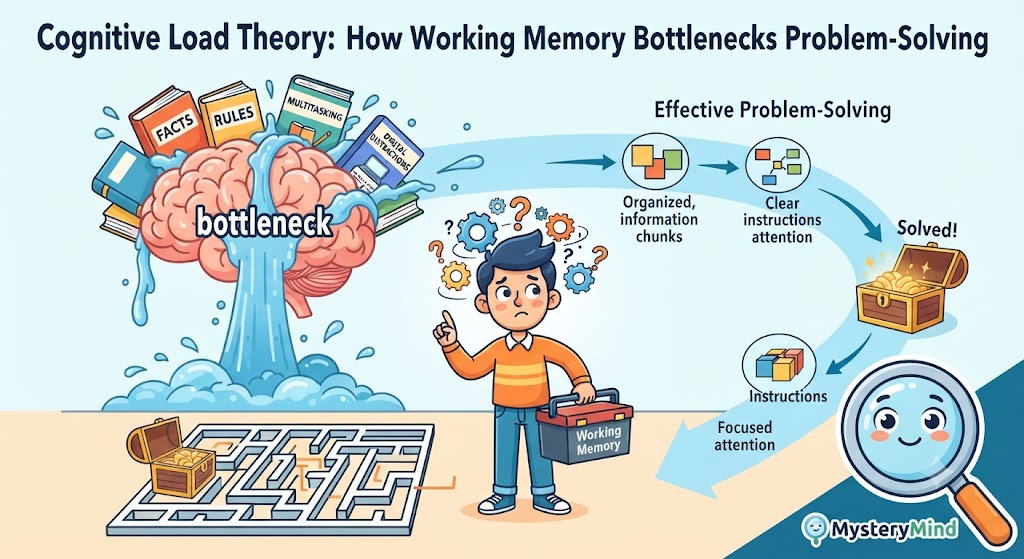
Human intellectual capability is characterized by an astonishing evolutionary paradox: while our long-term memory repository possesses essentially unlimited storage capacity, capable of retaining hundreds of thousands of complex conceptual schemas across a lifetime, the conscious gateway to that repository—working memory—is severely constrained by severe biological bottlenecks.
Formulated by Australian educational psychologist John Sweller in the late 1980s, Cognitive Load Theory (CLT) provides a rigorous neurocomputational framework explaining how the human cognitive architecture processes, organizes, and assimilates novel information. CLT posits that learning, problem-solving, and decision-making depend entirely upon how effectively information is structured to respect the finite metabolic and informational bandwidth of working memory.
When an instructional presentation, software interface, or analytical problem forces working memory to handle too many unorganized elements simultaneously, cognitive overload occurs. In this state, prefrontal executive networks become saturated, error rates spike exponentially, and the biological transition of information into permanent long-term memory schemas completely collapses. Deconstructing the neurobiology of cognitive load is paramount for educators, software architects, clinicians, and analytical professionals seeking to maximize intellectual throughput.
2. The Tripartite Taxonomy: Intrinsic, Extraneous, and Germane Loads
Cognitive Load Theory categorizes the total metabolic demand placed upon an individual’s working memory into three distinct, additive components:
1. Intrinsic Cognitive Load: This represents the inherent difficulty of the material itself, determined strictly by element interactivity. High element interactivity occurs when multiple variables cannot be understood in isolation and must be simultaneously processed in working memory (e.g., balancing a complex multi-variable redox reaction or calculating tensor equations in general relativity). Low element interactivity involves isolated learning tasks (e.g., memorizing a list of independent foreign language words). Intrinsic load cannot be arbitrarily removed without altering the nature of the learning objective.
2. Extraneous (Ineffective) Cognitive Load: This represents mental effort wasted on poorly designed instructional architecture, convoluted formatting, redundant explanations, or confusing visual layouts. When an engineering student must look back and forth between a diagram on one page and a separate textual legend on another (the Split-Attention Effect), working memory capacity is squandered on spatial navigation rather than conceptual understanding. Extraneous load contributes nothing to learning and must be ruthlessly eliminated.
3. Germane (Effective) Cognitive Load: Originally conceptualized as a separate load and now understood as the mental effort devoted to schema acquisition and schema automation. Germane load is the productive cognitive exertion an individual invests in synthesizing relationships, deducing underlying principles, comparing abstract analogies, and embedding new concepts into existing long-term memory structures.
The core equation of Cognitive Load Theory dictates that: Total Load = Intrinsic Load + Extraneous Load + Germane Load. If the sum of Intrinsic and Extraneous loads exceeds an individual’s working memory capacity, Germane processing becomes biologically impossible.
3. Neuroanatomical Substrates: Prefrontal Bandwidth and Glycogen Consumption
Functional neuroimaging (fMRI) and electroencephalography (EEG) have identified the precise neural correlates corresponding to escalating cognitive load:
Bilateral Dorsolateral Prefrontal Cortex (dlPFC) Saturation: As element interactivity scales, fMRI scans reveal a linear increase in BOLD signal within the bilateral dlPFC (Brodmann Areas 9 and 46). The dlPFC maintains active representations through persistent, recurrent glutamatergic firing among pyramidal neurons. However, once working memory capacity reaches its limit (roughly 4 independent chunks), prefrontal activation exhibits a sharp inflection point: BOLD activity plateaus, and if additional variables are introduced, the network abruptly destabilizes, resulting in catastrophic representational loss.
Anterior Cingulate Cortex (ACC) Error Signaling: The dorsal ACC continuously monitors processing conflicts and cognitive dissonance. Under excessive extraneous load, the ACC fires continuous warning signals, driving elevated autonomic arousal, pupil dilation, and increased sympathetic nervous system tone—the biological hallmark of cognitive frustration.
Frontal Midline Theta (FMT) Oscillations: EEG spectral analysis shows that escalating cognitive load is indexed by a dramatic increase in frontal midline theta power (4–8 Hz) recorded over electrode Fz. FMT oscillations reflect the active coordination of the central executive during working memory retention. When FMT power peaks and begins to desynchronize, it provides an electrophysiological marker of cognitive overload.
4. Schema Theory: How Long-Term Memory Bypasses the Working Memory Bottleneck
How do human experts solve in seconds problems that completely overwhelm novice brains? Cognitive Load Theory answers this question through the neurobiology of cognitive schemas:
What Is a Schema? A schema is an organized, hierarchical mental structure stored in long-term memory that encapsulates thousands of individual elements into a single, unified cognitive entity. In chess, while a novice sees 32 individual pieces with dozens of separate geometric movement rules (overwhelming intrinsic load), a grandmaster perceives a single, cohesive “King’s Indian Defense” or “Pawn Island”—treating dozens of interconnected coordinates as one single chunk in working memory.
Schema Automation and Neocortical Storage: Once a schema is repeatedly practiced and consolidated into the neocortex (mediated by the anterior temporal lobes and basal ganglia), it undergoes automation. Automated schemas can be retrieved and executed with near-zero working memory overhead and negligible prefrontal glucose consumption. This automation frees up almost 100% of available prefrontal working memory capacity to handle novel, unpredictable variables in the environment.
5. Classical Cognitive Load Effects: Evidence-Based Architectural Principles
Empirical research over three decades has documented numerous robust cognitive phenomena that dictate how information must be presented:
1. The Worked-Example Effect: For novices, forcing unguided problem-solving (such as discovery learning) generates massive extraneous cognitive load. Novices resort to inefficient “means-ends analysis,” which exhausts working memory without creating schemas. Providing complete, step-by-step worked examples eliminates extraneous load and directs 100% of cognitive resources toward schema abstraction.
2. The Split-Attention Effect: When instructional materials separate mutually dependent information across different physical spaces (e.g., text located beneath a diagram requiring cross-referencing), working memory is burdened with unnecessary mental integration. Physically integrating text directly into the relevant components of a diagram dramatically accelerates learning.
3. The Modality Effect: Working memory possesses two semi-independent sensory channels: the visuospatial sketchpad and the phonological loop. Presenting a visual animation accompanied by written text forces both streams into the visual buffer (inducing visual overload). Presenting the animation alongside spoken narration distributes the load across both the visual and auditory channels, doubling functional working memory bandwidth.
4. The Expertise Reversal Effect: Instructional designs that benefit novices often severely hinder experts. While novices require detailed worked examples and structured scaffolding, presenting those same step-by-step scaffolds to an expert forces them to mentally cross-reference the instructions against their own automated schemas—introducing heavy extraneous cognitive load!
Comparative Neuroanalytical Framework
To quantify the physiological, metabolic, and behavioral divergence across attentional states, the following high-density comparative matrix contrasts baseline operations against acute focus trajectories:
Actionable Clinical & Cognitive Protocols
Translating neurobiological theory into measurable intellectual performance requires standardized behavioral frameworks designed to optimize synaptic signaling and preserve metabolic substrates:
Protocol 1: The “Isolated-Elements” Segmentation Strategy
When encountering highly complex subjects with massive element interactivity (such as neuropharmacology or distributed system algorithms), never attempt to understand the holistic system immediately. Artificially strip away interactions: learn each element in isolation first, automate its individual schema, and only then combine them into an interactive network. This prevents intrinsic load from triggering prefrontal collapse.
Protocol 2: Spatial Integration to Eliminate Split-Attention
When designing slides, technical documentation, or study notes, physically embed descriptive text directly next to the anatomical or technical component it describes. Never use separate numerical legends or detached footnotes that require the reader’s eyes to dart back and forth across the page. Spatial integration saves hundreds of millijoules of prefrontal glucose per minute.
Protocol 3: Dual-Channel Bimodal Distribution (The Modality Principle)
When absorbing or communicating complex technical sequences, split the information across the visual sketchpad and phonological loop. Use dynamic visual diagrams to represent spatial relationships while using spoken audio (or self-directed inner speech) to convey explanatory narration. This effectively doubles working memory throughput compared to presenting dense text on a slide.
Protocol 4: Cognitive Offloading via External Scratchpads
Never attempt to hold intermediate computational states inside your biological working memory. Offload intermediate calculations, premises, and sub-goals onto paper or a digital canvas immediately. By converting an internal working memory load into an external perceptual representation, you spare the dlPFC for high-order synthesis and novel deduction.
Common Neuromyths, Pitfalls & Diagnostic Misattributions
- The “Discovery Learning” Trap: Forcing beginners to discover complex mathematical or scientific principles on their own without worked examples generates massive extraneous load. Novices burn all their mental energy on blind trial-and-error, learning misconceptions and forming zero coherent schemas.
- Visual Redundancy and Seductive Details: Adding decorative clip art, entertaining animations, or tangentially interesting trivia to presentations actually impairs comprehension. These “seductive details” hijack visual attentional buffers and consume precious working memory bandwidth.
- Ignoring the Expertise Reversal Effect: Treating an advanced professional like a beginner by forcing them to sit through granular, elementary step-by-step workflows induces severe cognitive frustration and degrades performance. Scaffolding must adapt dynamically to expertise level.
- Confusing Subjective Effort with Productive Learning: When extraneous cognitive load is sky-high, an individual feels exhausted and believes they are working hard. However, that exhaustion reflects wasted prefrontal friction rather than schema formation. Effort must be germane, not extraneous.
Frequently Asked Clinical Questions (FAQ)
How does Cognitive Load Theory explain why people freeze during high-stress exams?
High psychological stress and anxiety flood working memory with intrusive worry thoughts (‘What if I fail?’). These anxiety-driven thoughts occupy 2 to 3 chunks of precious prefrontal working memory capacity. As a result, the student has only 1 or 2 chunks remaining for the actual exam questions, triggering immediate cognitive overload and mental freezing.
Can working memory capacity be expanded to eliminate cognitive load?
While targeted working memory training can modestly enhance attentional control and buffer efficiency, biological working memory capacity remains strictly constrained by prefrontal anatomy. The true, biologically scalable method to overcome cognitive load is not expanding working memory itself, but acquiring and automating expansive long-term memory schemas.
What is the difference between split-attention and redundancy effects?
The split-attention effect occurs when multiple pieces of information are essential for comprehension but physically separated (requiring integration). The redundancy effect occurs when identical information is presented in multiple forms unnecessarily (e.g., reading aloud bullet points word-for-word that are already printed on a slide), forcing the brain to process identical data twice.
How does cognitive load relate to user interface (UI) and user experience (UX) design?
Every unnecessary click, hidden menu icon, inconsistent navigation button, or visually loud banner imposes extraneous cognitive load on the user. World-class UX design minimizes extraneous load so that 100% of the user’s attention is directed toward their primary objective, dramatically reducing task completion time and error rates.
What is ‘element interactivity’ and why is it so critical?
Element interactivity refers to the degree to which information elements depend on one another. Learning the names of 20 bones has low interactivity (each bone can be learned independently). Understanding how those 20 bones, 15 tendons, and 10 muscles coordinate during a complex orthopedic joint motion has high interactivity. High interactivity requires simultaneous processing, creating severe cognitive load.
Peer-Reviewed Scholarly References
- Sweller, J. (1988). Cognitive load during problem solving: Effects on learning. Cognitive Science, 12(2), 257-285.
- Paas, F., Renkl, A., & Sweller, J. (2003). Cognitive load theory and instructional design: Recent developments. Educational Psychologist, 38(1), 1-4.
- Cowan, N. (2010). The magical mystery four: How is working memory capacity limited, and why? Current Directions in Psychological Science, 19(1), 51-57.
- Sweller, J., Ayres, P., & Kalyuga, S. (2011). Cognitive Load Theory. Springer Science & Business Media.
- Kalyuga, S., et al. (2003). The expertise reversal effect. Educational Psychologist, 38(1), 23-31.
- Van Merrienboer, J. J., & Sweller, J. (2005). Cognitive load theory and complex learning: Recent developments and future directions. Educational Psychology Review, 17(2), 147-177.
- Mayer, R. E., & Moreno, R. (2003). Nine ways to reduce cognitive load in multimedia learning. Educational Psychologist, 38(1), 43-52.