1. Theoretical Foundations: Dopamine as an Epistemic Currency
In popular media, dopamine is frequently mischaracterized as the neurochemical substrate of pleasure, euphoria, or hedonistic satisfaction. In clinical neuroscience and neurobiology, however, dopamine (3,4-dihydroxyphenethylamine) serves an entirely different, infinitely more complex role: it is the central nervous system’s primary computational currency for reward prediction error (RPE), incentive salience, and cognitive effort allocation. Rather than signaling the arrival of a reward, dopamine fires to compute the differential between expected outcomes and reality, modulating whether an organism will sustain metabolic expenditure in pursuit of an epistemic or physiological objective.
From an evolutionary standpoint, sustained cognitive focus represents a bioenergetic gamble. The human brain constitutes roughly 2% of total body mass yet consumes approximately 20% of resting cerebral glucose and oxygen. Engaging the prefrontal cortex in protracted, non-automated analytical reasoning requires continuous neuronal firing within energy-intensive frontoparietal networks. Without a chemical signaling mechanism that continually affirms that the prospective outcome justifies the ongoing depletion of local adenosine triphosphate (ATP), the brain instinctively defaults to conservation modes, characterized behaviorally as distractibility, boredom, or mental exhaustion.
Dopamine operates as the neurochemical gatekeeper of this trade-off. When mesocortical projections saturate the dorsolateral prefrontal cortex (dlPFC), they increase the signal-to-noise ratio of neuronal ensembles, effectively suppressing internal task-irrelevant sensory noise and stabilizing working memory representations. Deep, protracted intellectual engagement is therefore not an act of mystical willpower, but a direct biophysical consequence of balanced dopaminergic tone across distinct subcortical and cortical circuits.
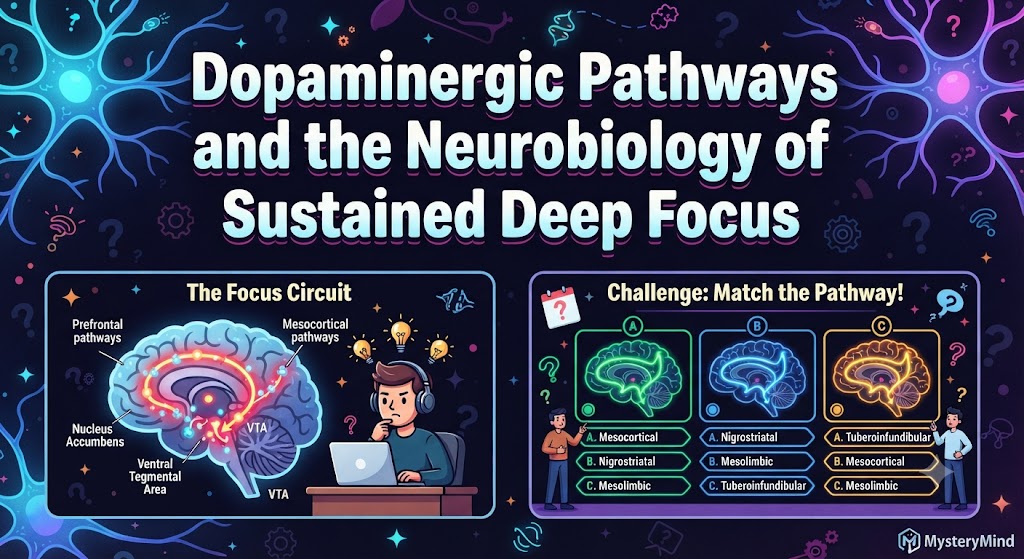
2. Anatomical Substrates: The Four Dopaminergic Pathways
To understand how attentional vigilance is generated and eroded, we must dissect the four major dopaminergic pathways originating within the midbrain and projecting throughout the neuraxis:
- The Mesocortical Pathway: Originating in the ventral tegmental area (VTA) and terminating within the prefrontal cortex, this tract is the structural engine of executive function, goal-directed planning, working memory maintenance, and selective attentional gating. Hypodopaminergic states in this pathway precipitate cognitive lethargy, executive dysfunction, and an inability to resist ambient distractors.
- The Mesolimbic Pathway: Also originating in the VTA but projecting to the nucleus accumbens, amygdala, and hippocampus, the mesolimbic tract mediates motivational salience, anticipation, reinforcement learning, and exploratory drive. When hyper-stimulated by hyper-palatable digital stimuli (such as variable-reward notifications), this pathway hijacking shifts attentional resources away from long-term intellectual goals toward immediate dopamine spikes.
- The Nigrostriatal Pathway: Extending from the substantia nigra pars compacta to the dorsal striatum (caudate and putamen), this pathway governs motor planning, procedural memory execution, and the transition of conscious focus into subconscious cognitive automation. Degradation here impairs not only somatic movement but also cognitive flexibility and task-switching fluidity.
- The Tuberoinfundibular Pathway: Projecting from the arcuate nucleus of the hypothalamus to the pituitary gland, this circuit regulates prolactin secretion. While less directly implicated in immediate attention, its neuroendocrine feedback loops influence overall vitality, libido, and systemic metabolic homeostasis.
3. Tonic versus Phasic Firing and the Inverted-U Hypothesis
A critical neurochemical distinction governing focus is the kinetic divergence between tonic and phasic dopamine transmission:
Tonic Dopamine: Represents the continuous, steady-state baseline concentration of dopamine circulating in the extracellular space, maintained by spontaneous, low-frequency pacemaker firing of dopaminergic neurons (1–5 Hz) and clearance rates governed by the dopamine transporter (DAT) and catechol-O-methyltransferase (COMT). Tonic dopamine determines overall baseline motivation, mood stability, and the threshold required to initiate effortful action.
Phasic Dopamine: Characterized by rapid, high-frequency burst firing (>20 Hz) triggered by novel stimuli, salient cues, or unexpected rewards. Phasic bursts generate sharp, transient spikes in concentration within the synaptic cleft, signaling that something worthy of immediate cognitive re-allocation has occurred. In modern hyper-stimulated environments, continuous exposure to unpredictable digital rewards triggers recurrent phasic bursts, progressively down-regulating tonic baseline levels and desensitizing postsynaptic receptors.
This dynamic intersects with the landmark Yerkes-Dodson Law and the Inverted-U Hypothesis of prefrontal dopamine signaling. Optimal cognitive performance in the prefrontal cortex requires an exact, intermediate concentration of dopamine. Sub-optimal dopamine levels fail to sufficiently stimulate high-affinity D1 receptors, leaving neural representations unstable and susceptible to decay. Conversely, excessive dopaminergic signaling (such as during acute extreme psychological stress or high-dose stimulant administration) floods low-affinity D2 receptors and alpha-1 adrenergic receptors, provoking cognitive fragmentation, hyper-arousal, perseverative loops, and a loss of analytical perspective.
4. Receptor Pharmacology: The Opposing Dynamics of D1 and D2 Receptors
At the cellular level, the physiological consequences of dopamine release depend entirely upon the specific receptor subtypes expressed on postsynaptic dendritic spines:
D1-Like Receptor Family (D1 and D5): G-protein-coupled receptors linked to the Gs/olf alpha subunit that stimulate adenylyl cyclase, elevating intracellular cyclic adenosine monophosphate (cAMP) and protein kinase A (PKA). In the dlPFC, moderate D1 activation selectively enhances the signal of the current task by dampening irrelevant subcortical noise. D1 receptor stimulation is what allows a researcher, software architect, or student to maintain a single complex conceptual model in working memory for 90 minutes without succumbing to divergent thoughts.
D2-Like Receptor Family (D2, D3, and D4): Coupled to Gi/o proteins that inhibit adenylyl cyclase and decrease cAMP production. In the striatum, D2 receptor activation promotes cognitive flexibility, disinhibition, and behavioral updating. However, excessive D2 receptor activity within the prefrontal cortex diminishes the stability of task-related representations, triggering rapid task-switching, distractibility, and impulsivity.
Achieving sustained intellectual endurance is essentially an exercise in maintaining a robust D1-dominant prefrontal state while preventing striatal D2-driven distractibility cascades.
5. Landmark Neuroimaging Trials and Human Empirical Research
Empirical verification of these mechanisms has been robustly documented in contemporary human neuroimaging trials:
Positron Emission Tomography (PET) Striatal Binding Studies (Volkow et al.): Pioneering radiotracer studies utilizing [11C]-raclopride demonstrated that human subjects exhibiting higher baseline D2/D3 receptor availability in the dorsal striatum consistently demonstrate superior performance on sustained attention tasks (such as the Continuous Performance Test). Furthermore, chronic exposure to fragmented multimedia consumption was correlated with significant decreases in striatal dopamine receptor availability, directly paralleling clinical attention deficits.
Functional MRI and Frontoparietal Coherence (Cools, D’Esposito, et al.): In landmark pharmacological fMRI paradigms utilizing dopamine agonists and antagonists, researchers established that the administration of bromocriptine (a D2 agonist) or methylphenidate modulates frontoparietal blood-oxygen-level-dependent (BOLD) signaling strictly according to baseline working memory capacity. Individuals with lower baseline synthesis capacity exhibited marked cognitive gains, whereas subjects with naturally high baseline synthesis suffered cognitive impairment from identical dosages—providing irrefutable empirical validation of the inverted-U curve in living human brains.
The COMT Val158Met Polymorphism: Genetic investigations of catechol-O-methyltransferase demonstrate that individuals possessing the Met/Met allele (which degrades prefrontal dopamine up to four times more slowly due to reduced enzymatic stability at body temperature) demonstrate significantly superior working memory, executive focus, and fluid reasoning compared to Val/Val carriers. However, under acute emotional stress, Met/Met individuals experience rapid cognitive degradation due to dopamine flooding past the peak of the inverted-U curve, whereas Val/Val individuals paradoxically improve their focus under pressure.
Comparative Neuroanalytical Framework
To quantify the physiological, metabolic, and behavioral divergence across attentional states, the following high-density comparative matrix contrasts baseline operations against acute focus trajectories:
| Neurobiological Parameter | Hypodopaminergic State (Under-Arousal) | Optimal Attentional Equilibrium | Hyperdopaminergic State (Over-Arousal) |
|---|---|---|---|
| Primary Receptor Binding | Insufficient D1/D2 receptor occupancy | Balanced prefrontal D1 signal stabilization | Excess D2/alpha-1 spillover; cAMP saturation |
| Subjective Cognitive Sensation | Apathy, brain fog, acute task resistance, boredom | Effortless cognitive immersion, flow state, deep clarity | Anxiety, cognitive racing, perseveration, irritability |
| Working Memory Capacity | Severely restricted (<3 chunks); high decay rate | Maximal (4–7 complex conceptual chunks) | Fragmented; high intrusion rate from worry/cues |
| Frontoparietal fMRI Connectivity | Decoupled; Default Mode Network (DMN) intrusion | High phase synchrony (theta-gamma coupling) | Hyper-coherent; failure of salience network filtering |
| Primary Metabolic Limiting Factor | Substrate synthesis; tyrosine hydroxylase inactivity | Sustained astrocytic glycogen and ATP utilization | Excess oxidative stress; mitochondrial fatigue |
Actionable Clinical & Cognitive Protocols
Translating neurobiological theory into measurable intellectual performance requires standardized behavioral frameworks designed to optimize synaptic signaling and preserve metabolic substrates:
Protocol A: The 90-Minute Ultradian Immersion Architecture
Human cognitive biology operates on cyclic endogenous 90-minute ultradian rhythms governed by basic rest-activity cycles (BRAC). Initiating a high-focus block requires passing through an initial 10-to-15 minute “friction phase” where prefrontal catecholamines (norepinephrine and dopamine) are actively recruited to suppress the Default Mode Network. Do not interpret this initial resistance as fatigue; it is the physiological warm-up of frontoparietal circuits. Maintain the focus block strictly within 75 to 90 minutes, followed immediately by 15 minutes of non-visual cognitive decompression (such as walking or eyes-closed auditory resting) to permit synaptic vesicle re-pooling.
Protocol B: Friction-Reward Decoupling and Internalized Salience
Conditioning the brain to rely on external rewards upon task completion (e.g., social media browsing, sweet food, or entertainment after finishing work) inadvertently reinforces the perception that the cognitive effort itself was an unpleasant penalty. To establish long-term attentional resilience, consciously attach dopamine release to the friction of the effort itself. By mentally reinforcing that the burning sensation of mental concentration is the physical manifestation of neuroplastic adaptation, you activate endogenous mesolimbic pathways during the struggle rather than solely at the termination line.
Protocol C: Targeted Nutritional Substrate Optimization
Dopamine biosynthesis initiates with the amino acid L-tyrosine, converted to L-DOPA via the rate-limiting enzyme tyrosine hydroxylase (which requires molecular oxygen, iron (Fe2+), and tetrahydrobiopterin (BH4) as essential cofactors). Ensure adequate dietary intake of bioavailable tyrosine-rich substrates (e.g., pasture-raised eggs, lean poultry, wild fish, or fermented dairy) during morning feeding windows. Furthermore, preserve intracellular receptor sensitivity by avoiding high-glycemic spikes prior to deep work, as rapid insulin fluctuations alter large neutral amino acid transport across the blood-brain barrier.
Common Neuromyths, Pitfalls & Diagnostic Misattributions
Scientific misconceptions surrounding dopamine have proliferated in recent years. Addressing these errors is essential for clinical accuracy:
- The Myth of the ‘Dopamine Fast’: You cannot “deplete” or “empty” your brain’s dopamine supply through typical modern behavior, nor does dopamine function like a gas tank that becomes physically dry. Rather, the issue is postsynaptic receptor desensitization and elevated thresholds for phasic activation. Complete sensory deprivation for 24 hours does not reset neurobiology; rather, systematic elimination of hyper-stimulating micro-rewards allows postsynaptic D2 receptors to re-sensitize over weeks.
- Stimulant Over-Reliance and Receptor Downregulation: Utilizing supra-physiological doses of synthetic stimulants forces massive non-vesicular release of dopamine via reverse transport through DAT. Over prolonged periods, the brain compensates through compensatory receptor internalization and profound down-regulation of endogenous tyrosine hydroxylase, leaving baseline unmedicated focus significantly worse than the original physiological baseline.
- Confusing Agitation with Focus: High norepinephrine without balanced prefrontal D1 dopamine produces frantic, highly scattered physical energy that mimics productivity but severely degrades high-level conceptual synthesis, abstract deduction, and working memory fidelity. True deep focus is calm, sustained, and metabolically stable.
Frequently Asked Clinical Questions (FAQ)
How long does it take for down-regulated dopamine receptors to normalize after digital over-stimulation?
Human PET imaging and clinical addiction literature indicate that significant re-sensitization and upregulation of D2/D3 receptors begins within 14 to 21 days of removing supra-normal stimuli. Substantial baseline neurochemical recovery typically requires 60 to 90 days of structured, consistent behavioral modulation.
Does caffeine increase dopamine levels directly?
Caffeine does not directly stimulate dopamine synthesis or vesicle release. Instead, it operates primarily as an adenosine receptor antagonist (predominantly A1 and A2A subtypes). By blocking adenosine from binding to striatal neurons, caffeine indirectly enhances dopamine D2 receptor responsiveness and structural accessibility to circulating endogenous dopamine.
Why is it so difficult to concentrate immediately after waking up?
Upon awakening, the brain undergoes sleep inertia, characterized by high residual levels of adenosine and low baseline frontoparietal connectivity. Cortical catecholamine synthesis requires approximately 30 to 60 minutes to establish optimal tone, stimulated by morning circadian sunlight exposure, light physical movement, and core body temperature elevation.
Can intense aerobic exercise boost prefrontal dopamine?
Yes. Aerobic exercise exceeding 65% VO2 max stimulates systemic calcium influx, which activates calmodulin-dependent protein kinase II (CaMKII), directly phosphorylating and accelerating the activity of tyrosine hydroxylase. This increases both central dopamine and brain-derived neurotrophic factor (BDNF) synthesis for several hours post-exercise.
How does chronic psychological stress impair dopamine-driven focus?
Chronic stress elevates systemic glucocorticoids (cortisol), which persistently stimulate the locus coeruleus to dump excess norepinephrine into the prefrontal cortex. This high-stress state bypasses the dlPFC and shifts control to subcortical survival hubs (amygdala and ventral striatum), impairing complex logical reasoning and increasing susceptibility to compulsive habits.
Peer-Reviewed Scholarly References
- Schultz, W. (2016). Dopamine reward prediction-error signalling: a two-component response. Nature Reviews Neuroscience, 17(3), 183-195.
- Volkow, N. D., Wang, G. J., Fowler, J. S., et al. (2011). Decreased striatal dopamine D2 receptors in humans with cognitive fatigue. Molecular Psychiatry, 16(11), 1147-1154.
- Cools, R., & D’Esposito, M. (2011). Inverted-U-shaped dopamine actions on human working memory and cognitive control. Biological Psychiatry, 69(12), e113-e125.
- Arnsten, A. F. (2009). Stress signalling pathways that impair prefrontal cortex structure and function. Nature Reviews Neuroscience, 10(6), 410-422.
- Robbins, T. W., & Arnsten, A. F. (2009). The neuropsychopharmacology of fronto-executive function: monoaminergic modulation. Annual Review of Neuroscience, 32, 267-287.
- Wise, R. A. (2004). Dopamine, learning and motivation. Nature Reviews Neuroscience, 5(6), 483-494.