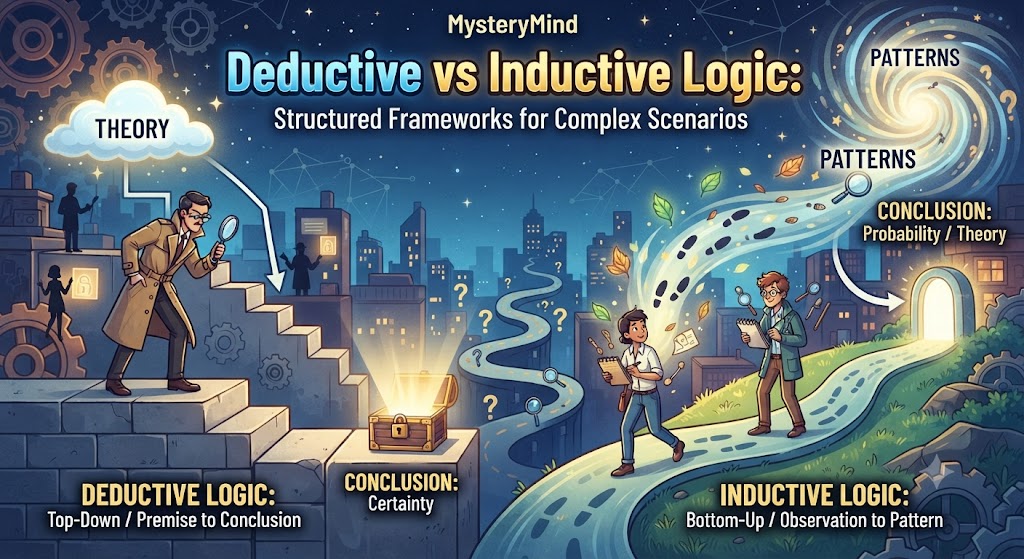
1. Philosophical and Epistemological Foundations: The Architecture of Truth
Human civilization’s greatest intellectual achievements—from the axiomatic geometry of Euclid and the calculus of Newton to the diagnostic algorithms of modern medicine and the legal architecture of constitutional law—rest upon structured reasoning. In classical formal epistemology, human rational thought is categorized into two foundational, complementary inferential engines: Deductive Logic and Inductive Logic.
Deductive Logic (Top-Down Necessity): Deduction moves from general universal premises to specific, inevitable conclusions. In a deductively valid argument, the relationship between premises and conclusion is one of absolute logical necessity: if the premises are true, it is impossible for the conclusion to be false. Deduction does not produce new empirical information about the physical world; rather, it unpacks, clarifies, and makes explicit what was already latent within the original axiomatic definitions.
Inductive Logic (Bottom-Up Probability): Induction moves in the opposing direction: from specific empirical observations to general probabilistic generalizations. In an inductive argument, even if all supporting premises are empirically verified and indisputably true, the conclusion is never guaranteed with 100% certainty; it is merely probable, plausible, or well-supported. Induction is the engine of the empirical scientific method, medical diagnosis, and machine learning: it synthesizes observed historical patterns to formulate predictive hypotheses about unseen future states.
Understanding the operational divergence between these two reasoning frameworks—and their neglected sibling, Abductive Logic (inference to the best explanation)—is essential for avoiding cognitive fallacies, optimizing analytical decision-making, and navigating chaotic high-stakes environments.
2. Formal Logical Mechanics: Validity, Soundness, and the Problem of Induction
To evaluate deductive and inductive claims rigorously, one must master the formal criteria of logical validity, soundness, and probabilistic strength:
Deductive Validity vs Soundness:
• Validity: A structural property of an argument. An argument is valid if the conclusion follows inevitably from the premises, regardless of whether the premises are factually true in the real world.
Premise 1: All mammals can breathe underwater.
Premise 2: Dogs are mammals.
Conclusion: Therefore, dogs can breathe underwater.
This argument is 100% deductively valid, but factually false because Premise 1 is untrue.
• Soundness: An argument is sound if and only if it is deductively valid AND all of its premises are empirically true in reality. Soundness guarantees absolute truth.
The Humean Problem of Induction: Formulated by Scottish philosopher David Hume in 1748, the “Problem of Induction” demonstrates that inductive generalizations can never be logically justified through pure deduction. Just because the sun has risen every morning for 10,000 consecutive days does not prove with mathematical necessity that it will rise tomorrow; we merely assume that nature’s laws are uniform.
This vulnerability was famously illustrated by Bertrand Russell’s inductivist turkey, which was fed every morning at 9:00 AM. After months of daily observation, the turkey formulated an inductively robust law: “I am always fed at 9:00 AM.” On Christmas Eve, instead of being fed, its neck was wrung. Inductive logic is forever vulnerable to “Black Swan” events that violate past empirical data.
3. Neuroanatomical Dissociation: The Dual-Brain Systems of Deduction vs Induction
Functional neuroimaging (fMRI) and lesion studies demonstrate that deductive and inductive reasoning recruit distinct, dissociable neural architectures within the human brain:
Left Inferior Frontal Gyrus (Brodmann Area 44/45): The Syntactic Deductive Hub: When individuals evaluate formal syllogistic deductions (e.g., Modus Ponens: If P then Q; P; therefore Q), fMRI scans reveal intense, focal activation within the left inferior frontal gyrus (Broca’s area) and left superior parietal lobule. The brain processes deductive logic through linguistic-syntactic rule engines: it treats premises like a formal grammar, stripping away semantic real-world meaning to check structural logical consistency.
Bilateral Dorsolateral Prefrontal and Medial Frontal Networks: Inductive Estimation: In contrast, when participants perform inductive reasoning (e.g., evaluating whether an observed pattern of symptoms indicates a specific disease, or estimating the likelihood of an outcome), activation shifts toward the bilateral dlPFC (BA 9/46), the anterior insular cortex, and the medial prefrontal cortex. Induction requires probabilistic estimation, uncertainty management, and risk evaluation, recruiting executive circuits that interface with emotional saliency markers.
The “Belief-Bias Effect” and Frontal-Temporal Conflict: When the factual truth of a premise conflicts with its logical validity (e.g., a valid argument with an absurd conclusion), an intense neural tug-of-war occurs between the left temporal semantic lobe (which screams “that conclusion is factually ridiculous!”) and the right inferior frontal gyrus (which attempts to preserve logical rules). Individuals with strong executive inhibition successfully override the belief bias to judge pure structural validity.
4. Abductive Inference: The Third Pillar of Clinical and Investigative Deduction
In real-world medical clinics, criminal investigations, and complex systems debugging, pure deduction and pure induction are often insufficient. We frequently operate under conditions of incomplete, messy, and noisy data. This requires Abductive Reasoning, introduced by American pragmatist Charles Sanders Peirce:
Inference to the Best Explanation (IBE): Abduction begins with an observed anomaly or symptom cluster (Observation $O$) and works backward to infer the most probable, parsimonious causal hypothesis ($H$) that would account for the anomaly.
• Fact: The patient presents with acute fever, stiff neck, and petechial rash.
• Abductive Hypothesis: Acute meningococcal meningitis is the most plausible, urgent causal explanation that unifies all three findings.
Occam’s Razor vs Hickam’s Dictum: Abductive inference balances two competing clinical and analytical principles:
1. Occam’s Razor (Lex Parsimoniae): Plurality should not be posited without necessity. Prefer the single simplest hypothesis that explains all observed data.
2. Hickam’s Dictum: “A patient can have as many diseases as they please.” In complex real-world systems, multiple independent failure modes often co-occur simultaneously, cautioning against over-simplifying multi-causal breakdowns.
5. Cognitive Fallacies: Affirming the Consequent and Base-Rate Neglect
Human reasoning is chronically susceptible to specific formal and informal fallacies that corrupt deductive and inductive conclusions:
1. Affirming the Consequent (Formal Deductive Fallacy):
Rule: If it rains, the street is wet.
Observation: The street is wet.
Erroneous Conclusion: Therefore, it rained.
The error lies in ignoring alternative causes (a burst water main, a street cleaning truck). In symbolic logic: $(P \implies Q) \land Q
ot\implies P$.
2. Denying the Antecedent:
Rule: If you are an Olympic marathoner, you are physically fit.
Premise: John is not an Olympic marathoner.
Erroneous Conclusion: Therefore, John is not physically fit.
Symbolic logic: $(P \implies Q) \land
eg P
ot\implies
eg Q$.
3. Base-Rate Neglect (Inductive Fallacy): Evaluating the probability of a hypothesis based entirely on descriptive representativeness while ignoring the underlying statistical prevalence (base rate) in the population.
Comparative Neuroanalytical Framework
To quantify the physiological, metabolic, and behavioral divergence across attentional states, the following high-density comparative matrix contrasts baseline operations against acute focus trajectories:
Actionable Clinical & Cognitive Protocols
Translating neurobiological theory into measurable intellectual performance requires standardized behavioral frameworks designed to optimize synaptic signaling and preserve metabolic substrates:
Protocol 1: Syllogistic Truth-Table Deconstruction
When analyzing a complex argument or policy proposal, explicitly separate validity from truth. Rewrite the argument into standard symbolic syllogistic form ($P \implies Q$). Strip out emotional buzzwords. Evaluate the validity of the syntactic structure first. Only after validity is mathematically verified should you empirically fact-check each premise for soundness.
Protocol 2: The Popperian Falsification Stress-Test (Countering Induction)
Never attempt to prove an inductive hypothesis by accumulating confirming instances (a million white swans do not prove all swans are white). Adopt Karl Popper’s falsificationist protocol: actively design an experiment specifically to find the single black swan that would destroy your hypothesis. If the hypothesis survives ruthless attempts at falsification, its inductive corroboration increases exponentially.
Protocol 3: Structured Differential Abductive Matrix
In complex diagnostics or root-cause engineering breakdowns, construct a 2D differential matrix: list all competing candidate hypotheses across columns, and list all observed anomalies down rows. Score how well each hypothesis explains each finding. Reject hypotheses that require multiple improbable coincidences, honoring Occam’s Razor while checking for multi-system cascade failures.
Protocol 4: Explicit Identification of Hidden Suppressed Premises
In everyday rhetoric, most arguments are enthymemes—deductions with unstated, hidden premises (e.g., “Candidate X took money from Wall Street, so she cannot be trusted”). Force the suppressed premise into conscious awareness: “Hidden Premise: Anyone who receives corporate campaign donations is inherently untrustworthy.” Interrogating the unstated assumption instantly reveals logical brittleness.
Common Neuromyths, Pitfalls & Diagnostic Misattributions
- The “Belief-Bias” Trap: Judging an argument as logically valid simply because you personally agree with its conclusion. Valid logic can lead to false conclusions if premises are flawed, and invalid logic can accidentally stumble onto true facts.
- Treating Inductive Trends as Deductive Laws: Assuming that because an economic market or technological trend has risen for 10 years, it is mathematically bound to continue. Induction provides only probabilistic likelihood, never deductive permanence.
- Committing Affirming the Consequent: Assuming that because the predicted effect occurred, your specific hypothesized cause must be true. Multiple independent causes can produce identical downstream symptoms.
- Dogmatic Deductive Reductionism: Demanding 100% deductive proof before taking action in dynamic, empirical real-world scenarios. In business and medicine, waiting for deductive certainty leads to catastrophic paralysis; inductive probability must guide action.
Frequently Asked Clinical Questions (FAQ)
Can a deductive argument ever be false?
A deductively valid argument can have a false conclusion if one or more of its premises are factually untrue (meaning the argument is valid, but unsound). However, if an argument is valid AND all premises are factually true (a sound argument), the conclusion cannot be false under any circumstances.
How does machine learning utilize inductive logic?
Machine learning is the ultimate mathematical manifestation of induction. Neural networks ingest thousands or millions of specific historical training examples (inputs and labeled outputs) and inductively optimize weight matrices to generalize a predictive function. Like all induction, ML models are vulnerable to out-of-distribution shifts where new data violates past statistical patterns.
Why is Sherlock Holmes’ ‘deduction’ actually mislabeled?
In Arthur Conan Doyle’s stories, Sherlock Holmes claims to use ‘deduction.’ However, from a formal philosophical standpoint, Holmes almost exclusively uses Abductive Reasoning! When Holmes notices red clay on a client’s shoe and a unique cigar ash, he infers the most plausible explanation from incomplete clues—an abductive leap that is brilliant, but not mathematically guaranteed.
What is Modus Tollens and why is it so powerful in science?
Modus Tollens (denying the consequent) is a foundational deductive rule: If P implies Q, and Q is false, then P must be false ($(P \implies Q) \land eg Q \implies eg P$). It is the backbone of Karl Popper’s scientific falsification: if a theory predicts an experimental outcome Q, and experiment shows Q is false, the theory P is deductively refuted.
How does the brain resolve conflicts between logic and emotion?
When an emotionally cherished belief is logically challenged, fMRI reveals heightened activation in the ventromedial prefrontal cortex and amygdala (emotional self-defense), which down-regulates the dorsolateral prefrontal cortex. The brain actively suppresses formal logical deduction to protect subjective emotional equilibrium.
Peer-Reviewed Scholarly References
- Aristotle. (ca. 350 BCE). Prior Analytics.
- Hume, D. (1748). An Enquiry Concerning Human Understanding.
- Peirce, C. S. (1931). Collected Papers of Charles Sanders Peirce. Harvard University Press.
- Popper, K. (1959). The Logic of Scientific Discovery. Hutchinson & Co.
- Goel, V., & Dolan, R. J. (2003). Explaining modulation of reasoning by belief: an fMRI study. Cognition, 87(1), B11-B22.
- Osherson, D. N., et al. (1998). Distinct brain loci in deductive versus probabilistic reasoning. Neuropsychologia, 36(4), 369-376.
- Evans, J. S. B. (2003). In two minds: dual-process accounts of reasoning. Trends in Cognitive Sciences, 7(10), 454-459.