1. Historical and Theoretical Foundations: Demystifying the Subconscious
For over a century, popular culture and psychoanalysis romanticized the “subconscious mind” as a mystical, shadowy subterranean realm—a Freudian cauldron of repressed childhood traumas, primal erotic drives, and untamed id instincts. While Sigmund Freud correctly intuited that conscious awareness represents merely the tip of an immense mental iceberg, modern cognitive science and neuroscience have completely demystified this architecture.
In contemporary computational neuroscience, the subconscious is not a mystical Freudian cellar; it is the brain’s high-speed, highly optimized automated processing engine. The human nervous system processes approximately 11,000,000 bits of sensory information per second, yet conscious working memory (the central executive) can handle at most 40 to 50 bits per second! If every heart contraction, linguistic grammatical rule, visual depth calculation, and motor muscle micro-adjustment required conscious deliberation, the biological organism would instantly collapse under metabolic exhaustion.
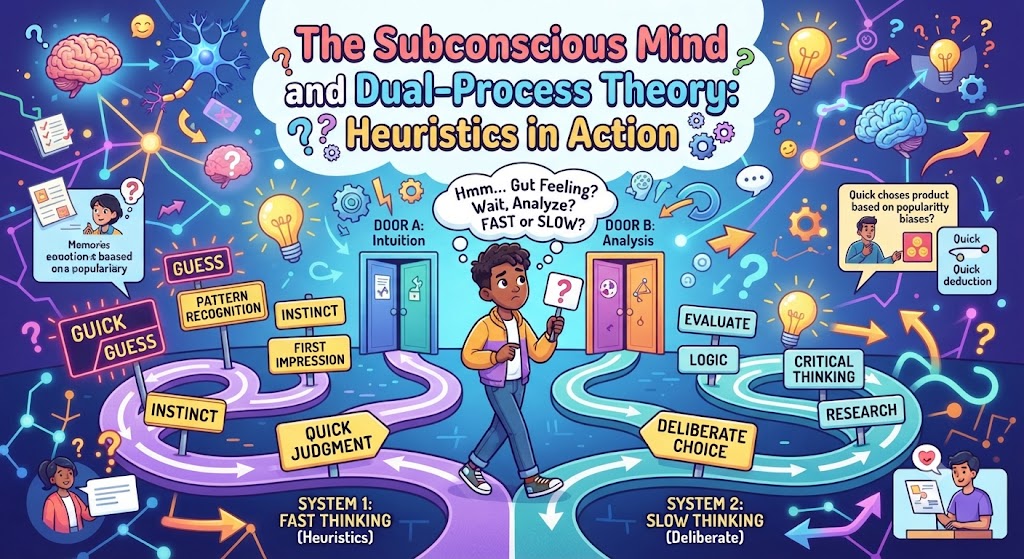
The structural framework that unites conscious and non-conscious processing is Dual-Process Theory, formulated across decades of cognitive psychology and brought to international prominence by Nobel laureate Daniel Kahneman and Amos Tversky in their masterpiece Thinking, Fast and Slow. By categorizing human cognition into two complementary processing modes—System 1 (Fast, Heuristic, Subconscious) and System 2 (Slow, Analytical, Conscious)—we can understand how the human mind navigates reality with breathtaking efficiency while falling prey to predictable, systematic cognitive illusions.
2. System 1 vs System 2: The Computational Dichotomy
Dual-Process Theory models human decision-making as an uneasy partnership between two fundamentally distinct computational operating systems:
System 1 (The Autonomous Subconscious Engine):
• Speed and Latency: Lightning-fast (firing in 10 to 150 milliseconds); executes thousands of parallel computations simultaneously.
• Conscious Effort: Zero subjective exertion; feels completely automatic, effortless, and involuntary. You cannot prevent your brain from reading a word printed in your native language or perceiving depth in a 3D room.
• Operational Logic: Operates by associative coherence, metaphor, emotional matching, and heuristics (mental shortcuts). It excels at instant facial recognition, driving a car on an empty highway, detecting anger in a voice, and swerving to avoid a sudden obstacle.
• Evolutionary Age: Extremely ancient; shared with all mammalian and vertebrate ancestors.
System 2 (The Deliberate Analytical Conductor):
• Speed and Latency: Sluggish, serial, and sequential; can only process one complex computation at a time.
• Conscious Effort: Extremely high subjective exertion; accompanied by elevated pupil dilation, tachycardia, and intense glucose/ATP consumption in the frontal lobes.
• Operational Logic: Governed by formal symbolic algebra, syntactic grammar, counterfactual simulation, and critical inhibition. It is responsible for calculating $17 imes 24$, parallel parking in a tight space, filling out tax forms, and checking deductive logic proofs.
• Evolutionary Age: Phylogenetically recent; unique to advanced primates and reaches its developmental apex in humans.
3. Neuroanatomical Substrates: Subcortical Automaticity vs Frontoparietal Control
Functional neuroimaging (fMRI) reveals that System 1 and System 2 correspond to anatomically dissociable neural circuits within the human brain:
System 1 Hubs: The Basal Ganglia and Cerebellar Automation: When a motor skill or cognitive sequence is repeated thousands of times (such as playing a musical scale, touch-typing on a keyboard, or shifting gears in a manual car), execution migrates from the conscious prefrontal cortex down into the dorsal striatum (caudate and putamen) of the basal ganglia and the cerebellum. These subcortical circuits execute pre-compiled “action chunks” with minimal glucose consumption and zero working memory overhead.
The Ventral Striatum and Amygdala: Affective Heuristics: Subconscious emotional intuitions and gut reactions are generated by the amygdala and nucleus accumbens. These structures assign immediate positive (“approach”) or negative (“avoid”) emotional valences to incoming stimuli before cortical processing even registers what the object is.
System 2 Hubs: The Frontoparietal Multiple-Demand Network: Conscious analytical deliberation requires the coordinated activation of the bilateral dorsolateral prefrontal cortex (dlPFC / BA 9/46), the anterior cingulate cortex (ACC), and the intraparietal sulcus (IPS). This network acts as a universal computational workbench: holding variables in working memory, monitoring for errors, and actively suppressing System 1’s automatic impulses.
4. Heuristics in Action: The Core Biases of Subconscious Processing
Because System 1 prioritizes speed and energy conservation over mathematical precision, it relies on heuristic attribute substitution—substituting a hard, complex question with an easy, intuitive one. This generates predictable cognitive biases:
1. The Availability Heuristic (Ease of Retrieval as Proxy for Frequency): When asked to estimate the probability of an event (e.g., plane crashes vs car accidents, or shark attacks vs falling coconuts), System 1 does not consult actuarial tables. It queries its subconscious memory buffer: “How easily can I recall a vivid mental image of this event?” Because dramatic plane crashes and shark attacks receive massive sensationalized media coverage, they are retrieved instantly, leading people to drastically overestimate their statistical frequency.
2. The Representativeness Heuristic (The Linda Problem): Kahneman and Tversky described “Linda”: 31 years old, single, outspoken, and deeply concerned with social justice. Participants were asked which is more probable:
A) Linda is a bank teller.
B) Linda is a bank teller and is active in the feminist movement.
Over 85% of people pick Option B! This violates elementary probability theory: the probability of two independent events occurring simultaneously ($A \cap B$) can never exceed the probability of a single event ($A$). But System 1 ignores probability; it matches Linda’s description to its internal stereotype of a feminist, committing the Conjunction Fallacy.
3. Anchoring and Adjustment: When estimating an unknown numerical quantity (e.g., the price of a house or the population of a country), an initial arbitrary number presented prior to the decision acts as a magnetic anchor. System 1 latches onto the anchor, and subsequent conscious adjustments by System 2 are notoriously sluggish and insufficient.
5. Strategic Integration: Bounded Rationality and Expert Intuition
Herbert Simon, the father of modern decision theory, introduced the concept of Bounded Rationality: human rationality is naturally bounded by cognitive limitations, finite working memory, and limited time. In real-world environments, pure System 2 optimization is impossible; humans must “satisfice”—selecting an option that meets an acceptable threshold rather than calculating infinity.
When Can You Trust Your Subconscious Intuition? (Kahneman & Klein):
Can intuition ever be trusted? In a historic collaborative paper, Daniel Kahneman (the skeptic of intuition) and Gary Klein (the champion of expert intuition) established the precise boundary conditions:
You can trust expert subconscious intuition if and only if two strict criteria are met:
1. The Environment Is High-Validity: The environment must possess objective, stable, and predictable causal regularities (e.g., firefighting, clinical medicine, classical chess, neonatal intensive care). In low-validity, chaotic environments (e.g., stock picking, long-term geopolitical forecasting), intuition is completely worthless.
2. The Individual Has Had Adequate Opportunity for Feedback: The practitioner must have spent years receiving rapid, unambiguous, and immediate empirical feedback on their decisions, allowing the basal ganglia to encode true patterns rather than delusions.
Comparative Neuroanalytical Framework
To quantify the physiological, metabolic, and behavioral divergence across attentional states, the following high-density comparative matrix contrasts baseline operations against acute focus trajectories:
Actionable Clinical & Cognitive Protocols
Translating neurobiological theory into measurable intellectual performance requires standardized behavioral frameworks designed to optimize synaptic signaling and preserve metabolic substrates:
Protocol 1: The “Cognitive Handshake” Checkpoint
Whenever preparing to make a significant financial, operational, or legal decision, implement a mandatory formal handshake between System 1 and System 2. Ask two sequential questions: 1. “What does my System 1 intuition want to do, and which emotional heuristic (availability, anchoring) is driving it?” 2. “What does an explicit System 2 mathematical spreadsheet say about the cold base rates?” Never act until both systems have formally documented their verdict.
Protocol 2: Availability Heuristic Antidote (Base-Rate Auditing)
Whenever an idea feels overwhelmingly probable because a vivid, recent anecdote is replaying in your mind (e.g., hearing about a startup competitor’s massive funding round or a friend’s catastrophic medical diagnosis), consciously ban that single anecdote. Query objective statistical databases: “What is the actual statistical base-rate across 10,000 cases in this reference class?” Replace vivid mental images with actuarial reality.
Protocol 3: Anchoring De-Biasing via Counter-Anchoring
In salary negotiations or contract acquisitions, when the opposing party drops an initial number onto the table, do not attempt to slowly bargain upward or downward from their number (System 2 will make insufficient adjustments). Execute a complete counter-anchor: immediately discard their proposed number from discussion, state your own independent valuation based on external market comps, and reset the gravitational center of the negotiation.
Protocol 4: Deliberate Habit Automation via Implementation Intentions
Harness the incredible speed of System 1 to automate positive behaviors by programming implementation intentions: “When Situation X occurs, I will automatically execute Action Y.” (e.g., “When I sit at my desk at 8:00 AM, I will open my code editor and enter a 45-minute sprint before checking email”). Repeating this contingency for 30 days transfers control from the fragile dlPFC to the automated dorsal striatum, building frictionless productivity habits.
Common Neuromyths, Pitfalls & Diagnostic Misattributions
- The “Trust Your Gut” Dogma in Low-Validity Domains: Blindly following “gut instinct” in chaotic, unpredictable environments like financial stock speculation or lottery picking. In low-validity environments, gut feelings are simply emotional noise and superstitious pattern-matching.
- Over-Taxing System 2 (Decision Fatigue): Attempting to consciously deliberate on hundreds of trivial decisions throughout the day (what to wear, what to eat, which pen to use). By 3:00 PM, prefrontal glycogen is depleted, leaving System 1 to make disastrous, impulsive choices. Automate minor decisions to preserve System 2 for high-stakes problems.
- Confusing Subjective Familiarity with Truth (The Illusory Truth Effect): Hearing a false statement repeated 10 times makes it feel cognitively fluent and familiar. System 1 equates familiarity with truth, accepting blatant lies as proven reality.
- Assuming System 2 Is Always in Control: Believing that you are a completely rational, conscious pilot of your mind. In neuroscience reality, System 1 runs 95% of your life automatically, with System 2 acting primarily as an overworked press secretary inventing post-hoc justifications.
Frequently Asked Clinical Questions (FAQ)
How does the subconscious mind differ between modern neuroscience and Freud’s psychoanalysis?
Freud viewed the unconscious as a repressed repository of forbidden desires, sexual conflicts, and emotional trauma. Modern cognitive neuroscience views the subconscious (System 1) as a sophisticated computational architecture: automated basal ganglia habits, parallel sensory filtration, predictive Bayesian modeling, and procedural memory buffers that allow the brain to survive without constant conscious friction.
Can you consciously turn off System 1?
No. System 1 is an autonomous, hardwired operational substrate that runs continuously and involuntarily. You cannot choose not to recognize a familiar face or not to feel startled by an explosion. However, you can train System 2 to become vigilant, monitor System 1’s outputs, and intercept biased impulses before they translate into physical action.
Why is the ‘Linda Problem’ so famous in psychology?
The Linda Problem proves that human intuition naturally prefers a detailed, believable story over cold mathematical probability. Even though the rule of probability dictates that Linda being a bank teller ($A$) must be more probable than Linda being a bank teller AND a feminist ($A \cap B$), over 85% of people pick the combined option because it sounds more representative of Linda’s personality.
How does sleep deprivation impair dual-process decision making?
Sleep loss selectively starves the dorsolateral prefrontal cortex of glucose and impairs adenosine clearance, effectively knocking System 2 offline. Under sleep deprivation, an individual operates on 100% System 1 automaticity—falling prey to extreme anchoring, emotional volatility, risk-seeking impulses, and confirmation bias.
How long does it take for a complex skill to migrate from System 2 to System 1?
Neuroimaging reveals that skill automation (transferring execution from the frontoparietal cortex to the basal ganglia and cerebellum) typically requires several hundred to several thousand deliberate repetitions over 6 to 12 weeks. Once automated into System 1, the skill can be executed flawlessly with near-zero working memory demand.
Peer-Reviewed Scholarly References
- Kahneman, D. (2011). Thinking, Fast and Slow. Farrar, Straus and Giroux.
- Tversky, A., & Kahneman, D. (1974). Judgment under uncertainty: Heuristics and biases. Science, 185(4157), 1124-1131.
- Simon, H. A. (1955). A behavioral model of rational choice. The Quarterly Journal of Economics, 69(1), 99-118.
- Kahneman, D., & Klein, G. (2009). Conditions for intuitive expertise: A failure to disagree. American Psychologist, 64(6), 515-526.
- Evans, J. S. B., & Stanovich, K. E. (2013). Dual-process theories of higher cognition: Advancing the debate. Perspectives on Psychological Science, 8(3), 223-241.
- Graybiel, A. M. (2008). Habits, rituals, and the evaluative brain. Annual Review of Neuroscience, 31, 359-387.
- Gigerenzer, G., & Gaissmaier, W. (2011). Heuristic decision making. Annual Review of Psychology, 62, 451-482.