1. Theoretical and Historical Foundations: Challenging the Pure-Reason Fallacy
For centuries, Western philosophical and economic dogma—from René Descartes’ dualism to Adam Smith’s rational actor model (Homo economicus)—treated emotion as the toxic, irrational saboteur of sound decision-making. The ideal decision-maker was romanticized as a cold, dispassionate calculating machine (exemplified in science fiction by Star Trek’s Mr. Spock) who systematically stripped away all affective feelings to evaluate choices through pure mathematical logic.
In the late 20th century, two revolutionary scientific paradigms utterly shattered this classical dogma:
1. The Psychometric Emergence of Emotional Intelligence (EQ): Pioneered by psychologists Peter Salovey and John Mayer, and popularized by Daniel Goleman in 1995, Emotional Intelligence was defined as the capacity to perceive, appraise, integrate, understand, and strategically regulate emotions to facilitate cognitive thought and interpersonal leadership.
2. Antonio Damasio’s Breakthrough in Behavioral Neurology: Clinical neurologist Antonio Damasio demonstrated that individuals with focal damage to the brain’s emotional integration centers (while retaining perfect 140+ IQ scores) become completely incapable of making rational, real-world decisions!
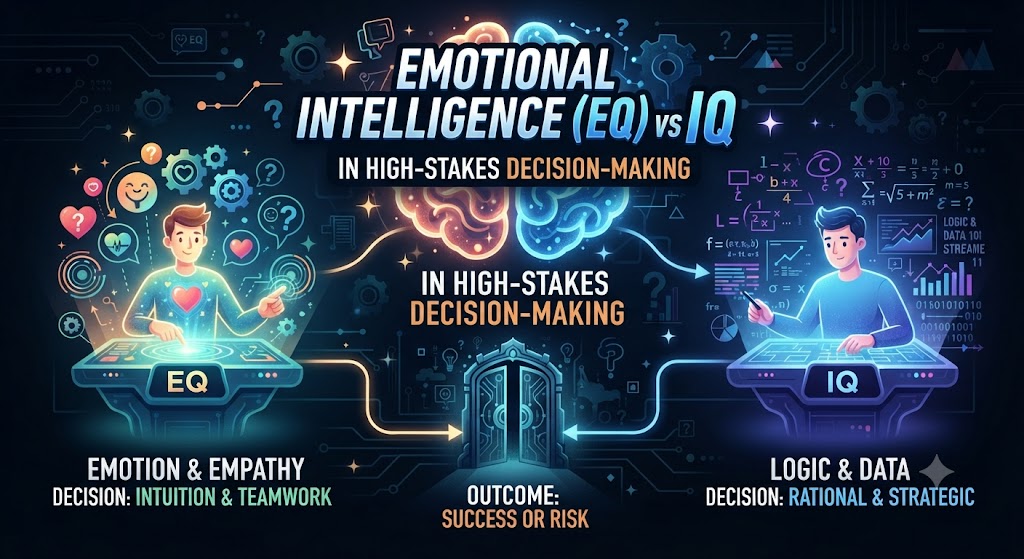
Modern cognitive neuroscience proves that high-stakes decision-making is not a battle between intellect and emotion; it is an intimate, mandatory neurocomputational partnership. Without cognitive intelligence (IQ), you cannot analyze options or compute complex probabilities. But without emotional intelligence (EQ) and somatic feedback, you cannot assign subjective value, prioritize goals, commit to action, or lead human organizations.
2. Antonio Damasio’s Somatic Marker Hypothesis: The Iowa Gambling Task
The most conclusive neurobiological proof that emotion is mandatory for rational choice came through Antonio Damasio’s study of patient “Elliot”:
The Case of Patient Elliot: Elliot was a brilliant, successful corporate executive who underwent surgery to remove a ventromedial prefrontal cortex (vmPFC) tumor. Post-surgery, Elliot’s cognitive faculties were completely intact: his IQ was superior, his memory was pristine, his mathematical ability was flawless, and he scored in the 99th percentile on abstract logic tests.
Yet, Elliot’s life disintegrated into catastrophic chaos. He could no longer make simple decisions: choosing between a blue or black pen consumed two hours of paralyzing, endless logical comparison. He entered disastrous business ventures that bankrupted him and divorced repeatedly. Why? Because Elliot had lost the neurological ability to feel emotion about choices. Without emotional valuation, every trivial option appeared equally valid, resulting in total decision paralysis.
The Somatic Marker Hypothesis: Damasio established that over a lifetime of experiences, the brain pairs specific environmental outcomes with visceral bodily sensations—termed Somatic Markers. When you contemplate a dangerous investment, a somatic alarm triggers before conscious thought: your stomach tightens, heart rate shifts, and skin conductance surges. These autonomic bodily signals act as an unconscious, high-speed filter that automatically eliminates 95% of disastrous options before working memory even begins its calculations.
The Iowa Gambling Task (IGT) Landmark Experiment: Participants draw cards from four decks:
• Decks A and B offer high immediate cash payoffs ($100), but conceal massive, catastrophic penalties that guarantee severe net losses over time (“Bad Decks”).
• Decks C and D offer modest immediate cash payoffs ($50), but contain tiny penalties that produce steady net gains (“Good Decks”).
Healthy participants unconsciously develop anticipatory sweat spikes (Galvanic Skin Conductance) on their palms whenever reaching toward the dangerous Decks A and B around trial 10—long before they can articulate conscious reasoning at trial 50! Their emotional bodies figured out the trap 40 trials ahead of their conscious minds. Patients with vmPFC or amygdala damage never develop these somatic markers; they repeatedly draw from the toxic decks until financially wiped out, despite understanding the math.
3. Neuroanatomical Substrates: The Amygdala-Prefrontal Tug-of-War
High-stakes decision-making is governed by dynamic, bidirectional communication across a core cortico-limbic circuit:
The Ventromedial Prefrontal Cortex (vmPFC): The Emotional Value Integrator: Situated at the bottom of the frontal lobes directly above the eye sockets, the vmPFC integrates cognitive evaluations from the dorsolateral prefrontal cortex with visceral affective signals from the amygdala and insula. It computes the subjective “net emotional utility” of every option.
The Amygdala and the “High Road vs Low Road” (Joseph LeDoux): Sensory data entering the thalamus splits into two pathways:
• The Subcortical Low Road (Fast & Dirty): Projecting directly from thalamus to amygdala in under 12 milliseconds. It triggers immediate adrenaline release, tachycardia, and instinctive fight-or-flight reflexes before conscious evaluation occurs.
• The Cortical High Road (Slow & Accurate): Projecting from thalamus to sensory cortex to prefrontal cortex (taking 30 to 40 milliseconds). It evaluates context, checks nuances, and sends top-down inhibitory signals back to the amygdala to extinguish false alarms.
“Amygdala Hijacking”: Under extreme acute crisis or threat, the amygdala fires uncontrollably, flooding the nervous system with cortisol and norepinephrine. This completely overrides the high road, shutting down the dorsolateral prefrontal cortex and reducing a high-IQ executive to a primitive, reactive survival state. Emotional Intelligence is the neurobiological capacity of the prefrontal cortex to maintain top-down executive authority during acute amygdala surges.
4. The Mayer-Salovey-Caruso Four-Branch Model of Emotional Intelligence
In scientific psychometrics, the gold standard of ability-based EQ is the MSCEIT (Mayer-Salovey-Caruso Emotional Intelligence Test), which measures four distinct, hierarchical cognitive abilities:
Branch 1: Emotional Perception: The capacity to accurately identify emotions in faces, vocal intonations, posture, and environmental micro-cues. In executive negotiations, this allows a leader to detect transient micro-expressions of contempt or anxiety in a counterparty.
Branch 2: Emotional Facilitation of Thought: The ability to harness emotional states to enhance specific cognitive tasks. Positive affect broadens attention for creative brainstorming, while mild negative affect sharpens deductive error-checking and audit precision.
Branch 3: Emotional Understanding: The structural comprehension of emotional language, progression, and transitions (e.g., understanding how chronic frustration transitions into active betrayal, or how grief transforms into anger).
Branch 4: Strategic Emotional Regulation: The pinnacle of EQ: the deliberate modulation of one’s own affective states and the intentional influence of emotional climates within a group to achieve long-term collective goals.
5. Empirical Predictive Validity: The “Threshold Hypothesis” in Executive Leadership
In organizational psychology, the comparative utility of IQ versus EQ is governed by the Threshold Hypothesis:
IQ as a Necessary Gatekeeper: Cognitive intelligence is an indispensable prerequisite for entry into complex technical domains (medicine, quantum physics, software architecture, corporate law). To master advanced mathematics or legal precedent, you need an IQ roughly one standard deviation above the population mean ($IQ \ge 115$). However, once you enter elite environments where everyone possesses an IQ of 125+, IQ loses its discriminatory predictive power.
EQ as the Differentiating Catalyst: When everyone in the room is brilliant, what determines which executive rises to CEO, which surgeon builds an exceptional surgical department, or which founder inspires a venture team through a catastrophic market collapse? Empirical research reveals that 85% of elite performance differentiation is attributable to Emotional Intelligence. Leaders with high EQ inspire psychological safety, de-escalate toxic conflicts, negotiate win-win alliances, and remain unflappable under catastrophic crises.
Comparative Neuroanalytical Framework
To quantify the physiological, metabolic, and behavioral divergence across attentional states, the following high-density comparative matrix contrasts baseline operations against acute focus trajectories:
Actionable Clinical & Cognitive Protocols
Translating neurobiological theory into measurable intellectual performance requires standardized behavioral frameworks designed to optimize synaptic signaling and preserve metabolic substrates:
Protocol 1: Somatic Marker Calibration (Interoceptive Scanning)
Prior to signing a contract, committing capital, or delivering high-stakes feedback, sit in silence for 90 seconds and perform an internal somatic body scan: observe heart rate, respiratory depth, tension in the throat, and visceral sensations in the gut (anterior insula activation). If your logical spreadsheets look perfect but your body registers visceral nausea or constriction, do not override the somatic signal. Investigate what hidden operational risk your subconscious has detected.
Protocol 2: The “Affect Labeling” Prefrontal Down-Regulation Technique
When an intense surge of anger, panic, or betrayal erupts, immediately vocalize or write down the precise emotional state in granular, descriptive words (e.g., “I am experiencing intense indignation and fear of betrayal”). Matthew Lieberman’s fMRI research proves that the exact millisecond language is attached to an emotion, the right ventrolateral prefrontal cortex (rVLPFC) activates, sending instant inhibitory signals that down-regulate amygdala BOLD activation by up to 50%.
Protocol 3: The 90-Second Neurochemical Metabolic Flush
Dr. Jill Bolte Taylor established that when an amygdala trigger occurs, the resulting flood of adrenaline and noradrenaline has a biological lifespan of exactly 90 seconds to surge through the bloodstream and be metabolized. If emotional fury persists past 90 seconds, it is because your conscious thoughts are actively re-stimulating the circuit. During an acute provocation, freeze for 90 seconds, take slow physiological sighs (two quick inhales through the nose, one long exhale through the mouth), and allow the chemical wave to clear.
Protocol 4: Tactical Empathy in High-Conflict Negotiations
In tense executive standoffs, never counter an emotional attack with cold logical data (which triggers defensive cognitive dissonance). Deploy tactical empathy: explicitly summarize the counterparty’s underlying emotional fears and unstated grievances aloud: “It sounds like you feel unappreciated, and you’re worried that this restructuring will marginalize your department’s accomplishments.” Hearing their negative emotions acknowledged disarms their amygdala, restoring prefrontal collaborative reasoning.
Common Neuromyths, Pitfalls & Diagnostic Misattributions
- The “Cold Intellectual Arrogance” Trap: High-IQ leaders frequently believe that presenting undeniable logical facts is sufficient to persuade others. Humans are emotionally driven creatures; a technically flawless presentation delivered without empathy will be fiercely rejected by tribal threat circuits.
- Conflating Emotional Intelligence with Being “Nice”: High EQ is not people-pleasing, toxic positivity, or avoiding conflict. Elite EQ often requires delivering devastating, uncomfortable truths with surgical precision, empathy, and absolute calm.
- Emotional Suppression vs Regulation: Suppressing emotions (biting your tongue while boiling inside) elevates blood pressure, floods the brain with cortisol, and impairs memory recall. True emotional regulation alters the cognitive appraisal before the emotional surge erupts.
- Assuming EQ Can Substitute for Hard Competence: A warm, empathetic physician who lacks diagnostic knowledge will harm patients; a charismatic CEO who cannot read financial statements will bankrupt a company. EQ multiplies IQ; it cannot replace it.
Frequently Asked Clinical Questions (FAQ)
Can someone with a high IQ have a low EQ, and vice versa?
Yes. Psychometrically, IQ and EQ are essentially orthogonal constructs (r ≈ 0.10 to 0.20). An individual can be a mathematical genius who is completely blind to social cues, or an extraordinary, charismatic diplomat who struggles with abstract formal algebra. The ultimate high-stakes performers cultivate both faculties.
Why did patient Elliot lose the ability to make decisions after his tumor surgery?
The tumor resection damaged Elliot’s ventromedial prefrontal cortex (vmPFC). While his raw cognitive IQ remained 140+, his brain lost the biological connection to somatic emotional markers. Without emotional feelings of preference, value, or risk, all choices appeared equally flat, trapping him in endless, paralyzing logical loops.
How does sleep deprivation specifically damage Emotional Intelligence?
Sleep deprivation uncouples the prefrontal cortex from the amygdala. High-density fMRI shows that after a single night of sleep deprivation, the amygdala becomes 60% more hyper-reactive to negative stimuli, while prefrontal top-down emotional regulation collapses, triggering explosive irritability and impulsive risk-taking.
Can adults intentionally increase their Emotional Intelligence?
Yes. Unlike fluid IQ, which peaks in early adulthood and declines with age, Emotional Intelligence can be developed across a lifetime. Longitudinal studies prove that structured mindfulness, cognitive reappraisal training, and interoceptive awareness practice produce structural thickening in the anterior cingulate and increase prefrontal-amygdala connectivity.
What is ‘Affect Labeling’ and why does it work so quickly?
Affect labeling is the practice of naming your emotional state in precise words. Neuroimaging by Matthew Lieberman revealed that speaking or writing an emotional label recruits the right ventrolateral prefrontal cortex, which exerts direct, rapid GABAergic inhibition upon the amygdala, reducing biological stress reactivity within seconds.
Peer-Reviewed Scholarly References
- Damasio, A. R. (1994). Descartes’ Error: Emotion, Reason, and the Human Brain. Putnam.
- Salovey, P., & Mayer, J. D. (1990). Emotional intelligence. Imagination, Cognition and Personality, 9(3), 185-211.
- Goleman, D. (1995). Emotional Intelligence: Why It Can Matter More Than IQ. Bantam Books.
- Bechara, A., Damasio, H., & Damasio, A. R. (2000). Emotion, decision making and the orbitofrontal cortex. Cerebral Cortex, 10(3), 295-307.
- Lieberman, M. D., et al. (2007). Putting feelings into words: Affect labeling disrupts amygdala activity in response to affective stimuli. Psychological Science, 18(5), 421-428.
- LeDoux, J. (1996). The Emotional Brain: The Mysterious Underpinnings of Emotional Life. Simon & Schuster.
- Mayer, J. D., Salovey, P., & Caruso, D. R. (2008). Emotional intelligence: New ability or eclectic traits? American Psychologist, 63(6), 503-517.