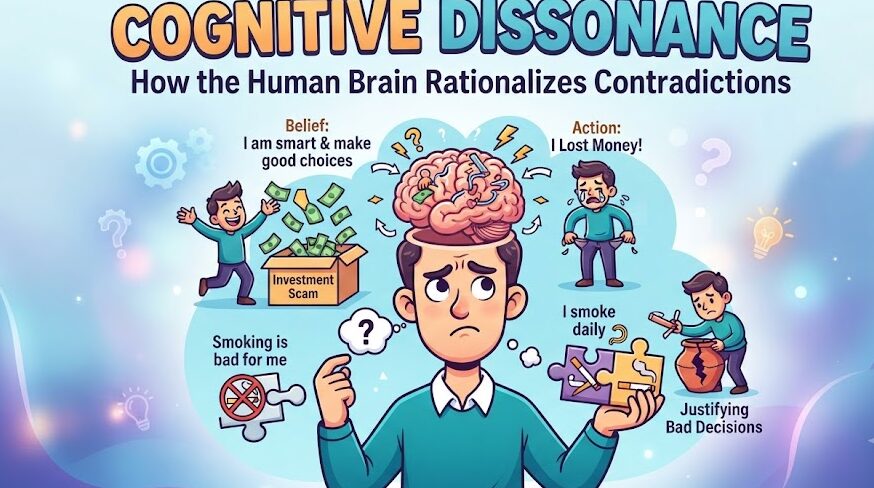
1. Historical and Theoretical Foundations: Leon Festinger’s Paradigm Shift
In 1954, social psychologist Leon Festinger infiltrated a doomsday UFO cult in Chicago led by Dorothy Martin (known in literature as Marion Keech). Martin had prophesied that catastrophic global floods would destroy the earth on December 21, but that true believers would be rescued at midnight by an alien flying saucer. When midnight arrived and passed with zero aliens, no flood, and total silence, Festinger witnessed an astonishing psychological phenomenon: rather than acknowledging their belief was objectively false, the cult members became even more fanatically convinced of their prophecy! They declared that their all-night vigil had radiated so much light that God spared the world.
This bizarre psychological adaptation led Festinger to formulate one of the most influential theories in social psychology and cognitive neuroscience: Cognitive Dissonance Theory (1957).
Cognitive dissonance is defined as the intense, aversive psychological and physiological state that erupts when an individual simultaneously holds two contradictory beliefs, values, or ideas, or when their observable behavior contradicts their self-identity (e.g., “I am a health-conscious person” vs. “I smoke two packs of cigarettes a day”). Festinger established that cognitive dissonance operates like a biological drive state—equivalent to extreme physical hunger or dehydration: the human nervous system cannot tolerate sustained dissonance and is biologically driven to eliminate the contradiction at all costs.
Crucially, Festinger discovered that because past physical actions cannot be undone, the human brain resolves the tension through an easier, cheaper route: retroactively altering its internal beliefs and rationalizing the behavior.
2. Classic Experimental Paradigms: Induced Compliance and Effort Justification
Over six decades of experimental psychology, two classic paradigms have illustrated the profound power of cognitive dissonance:
The $1 vs $20 Induced Compliance Experiment (Festinger & Carlsmith, 1959):
Participants were forced to perform an agonizingly boring task for an hour: repeatedly turning 48 wooden spools a quarter-turn, removing them, and replacing them. Afterwards, the experimenter asked the participant to lie to the next waiting subject by telling them the task was thrilling and fun.
• Group A was paid $20 (a substantial sum in 1959) to tell the lie.
• Group B was paid merely $1 to tell the lie.
Later, an independent evaluator asked participants how much they actually enjoyed the spool-turning task.
Common intuition predicts that the $20 group would rate the task higher. The actual experimental result was the exact opposite!
• The $20 group rated the task as completely boring. They had a sufficient external justification for lying (“I lied for $20; no dissonance”).
• The $1 group rated the task as genuinely enjoyable and fascinating! Why? They had told a lie for a paltry $1, creating unbearable dissonance: “I am an honest person, yet I lied for almost nothing.” To resolve this internal contradiction, their subconscious minds altered their actual memory of the experience: “I didn’t lie; the spool turning was actually quite therapeutic and interesting!”
Effort Justification (Aronson & Mills, 1959):
When individuals endure severe hazing, arduous pain, financial sacrifice, or immense time investment to join a group or complete a goal, their brains value the outcome exponentially higher than if it were obtained easily. If an initiation is grueling and the resulting group turns out to be mediocre, dissonance screams: “I suffered for nothing!” To escape this agony, the brain exaggerates the prestige, brilliance, and value of the group—a mechanism that fuels military camaraderie, medical residency endurance, and cult indoctrination.
3. Neuroanatomical Circuits: The Physical Pain of Contradiction
Groundbreaking functional neuroimaging (fMRI) studies conducted by Drew Westen, Matthew Lieberman, and Vincent van Veen have identified the precise neural circuitry mediating cognitive dissonance:
Dorsal Anterior Cingulate Cortex (dACC): Conflict and Distress: When participants are confronted with contradictory beliefs or forced to make difficult counter-attitudinal decisions, the dACC lights up intensely. The dACC is the neural hub of the “physical pain matrix” (the exact same region that registers physical burns or broken bones). Cognitive dissonance is not an abstract intellectual debate; the brain experiences a logical contradiction as literal physical discomfort!
Anterior Insula: The Somatic Distress Signal: Co-activating with the dACC, the anterior insular cortex processes visceral interoceptive sensations (gut discomfort, elevated heart rate, visceral tension). High insular BOLD activation directly correlates with an individual’s subjective distress when their hypocrisy is exposed.
Ventromedial Prefrontal Cortex (vmPFC) and Posterior Cingulate: The Rationalization Engine: Once the dACC and insula fire the distress alarm, the vmPFC and precuneus engage. These areas coordinate with memory stores to rewrite narratives, invent justifications, and re-weight preferences. The instant rationalization occurs, the dACC and insular pain signals immediately subside, followed by a surge of dopamine in the nucleus accumbens—rewarding the brain for successfully restoring internal harmony!
4. Post-Decisional Spreading of Alternatives: The Free-Choice Paradigm
What happens after you make a difficult choice between two equally attractive options (e.g., choosing between two dream job offers or two luxury cars)?
The Spreading of Alternatives: Jack Brehm discovered that prior to making a decision, an individual rates Option A and Option B with almost identical scores (e.g., 85/100 each). However, the moment Option A is chosen and Option B is rejected, a profound psychological re-calibration occurs:
• The rating of the chosen Option A escalates to 95/100.
• The rating of the rejected Option B plummets to 60/100.
Why does the brain do this? Contemplating the desirable traits of the rejected option creates acute dissonance: “I rejected a great option; maybe I made a mistake.” To eliminate this regret before it can fester, the brain artificially elevates the virtues of the chosen alternative while actively seeking out and exaggerating the flaws of the rejected alternative. Once a choice is locked in, our brains actively rewrite reality to make us fall in love with our decision.
5. Modern Societal Pathology: Political Tribalism and the “Backfire Effect”
In the modern socio-political landscape, cognitive dissonance explains the phenomenon of political tribalism, conspiratorial radicalization, and the legendary Backfire Effect:
Drew Westen’s Political Neuroimaging Landmark: During the 2004 US Presidential election, neuroscientist Drew Westen placed committed Democrats and Republicans in fMRI scanners and exposed them to blatant, undeniable factual contradictions committed by their own favored candidate.
The fMRI scans revealed that when seeing their candidate’s hypocrisy, the neural circuits responsible for objective mathematical and logical reasoning (dlPFC) were completely shut down! Instead, the emotional conflict network (dACC and insula) flared up, followed immediately by massive activation in the posterior cingulate and vmPFC as the brain feverishly generated partisan defenses. When an acceptable rationalization was found, the reward center (nucleus accumbens) lit up with dopamine. Westen concluded: “The brain seeks psychological relief, not factual truth.”
The Escalation of Commitment in Failed Investments: Corporate CEOs and project managers frequently pour millions of dollars into doomed projects (“sunk cost fallacy”). Acknowledging that past capital was wasted triggers unbearable dissonance; continuing to invest allows the executive to preserve the fiction that the strategy was brilliant all along.
Comparative Neuroanalytical Framework
To quantify the physiological, metabolic, and behavioral divergence across attentional states, the following high-density comparative matrix contrasts baseline operations against acute focus trajectories:
Actionable Clinical & Cognitive Protocols
Translating neurobiological theory into measurable intellectual performance requires standardized behavioral frameworks designed to optimize synaptic signaling and preserve metabolic substrates:
Protocol 1: Somatic Dissonance Recognition (The Gut Distress Alarm)
Train yourself to detect the physiological onset of cognitive dissonance. When someone presents evidence contradicting your cherished belief, notice the physical sensations: tightening chest, sudden defensive heat in the face, clenched jaw (dACC and anterior insula activation). Treat this visceral physical distress not as a signal to fight back, but as an objective diagnostic notification: “My brain has just detected a contradiction. Stop. Do not rationalize.”
Protocol 2: Decoupling Ego Identity from Factual Hypotheses
The primary fuel for cognitive dissonance is ego threat. When an idea is linked to identity (“I am a Bitcoin maximalist” or “I am an agile purist”), disconfirming evidence feels like physical ego death. Adopt the scientific stance: “I am not my beliefs; I am an observer testing hypotheses.” If a hypothesis fails an empirical test, discard it with gratitude rather than shame.
Protocol 3: The Sunk-Cost “Clean-Slate” Audit
When deciding whether to continue an underperforming investment, relationship, or project, ban all consideration of past time, money, or effort already spent. Past investments are non-recoverable sunk costs. Ask the Clean-Slate Question: “If I walked into this situation today with zero prior history, would I invest fresh capital in this opportunity right now?” If no, pull the plug immediately.
Protocol 4: The Steel-Manning Exercise
Counteract selective exposure by regularly practicing ideological steel-manning. Take the perspective of an opponent or competing business model and write down the strongest, most compelling, and persuasive version of their argument—to the point where the opponent would say: “Yes, you have captured my position better than I could.” Steel-manning forces the prefrontal cortex to process disconfirming evidence, dissolving dogmatic dissonance.
Common Neuromyths, Pitfalls & Diagnostic Misattributions
- The “Doubling Down” Reaction: When exposed to evidence proving you wrong, the instinctive urge is to become more entrenched and aggressive. Recognizing this reaction is the hallmark of emotional maturity and intellectual honesty.
- Confusing Emotional Relief with Rational Truth: Just because a rationalization makes you feel comfortable and relieves internal tension does not mean it is factually valid. The brain rewards rationalization with dopamine; true truth often feels painful.
- Attacking the Messenger: When an inconvenient fact threatens your self-concept, the easiest dissonance reduction strategy is discrediting the source (“They are biased; they have an agenda”). Always separate the factual argument from the character of the speaker.
- Assuming High Intelligence Protects You: Highly intelligent people possess superior verbal and creative faculties to construct far more sophisticated rationalizations. Intelligence without self-awareness makes cognitive dissonance far more dangerous.
Frequently Asked Clinical Questions (FAQ)
Why did the doomsday cult members become more devoted after the prophecy failed?
Cult members had given up their jobs, sold their houses, and alienated their families to wait for the flying saucer. Acknowledging that the prophecy was a delusion would mean accepting that they had destroyed their lives for nothing—an unbearable level of cognitive dissonance. Inventing the rationalization that ‘their faith saved the world’ allowed them to preserve their self-worth, making them even more fanatical.
How does cognitive dissonance relate to the Sunk Cost Fallacy?
The sunk cost fallacy is a direct manifestation of cognitive dissonance. Admitting that an investment of 5 years or $100,000 was a mistake triggers intense dACC pain. Pouring more resources into the losing endeavor allows the individual to defer the admission of failure and temporarily suppress the dissonance.
What happens in the brain when an individual finally admits they were wrong?
Admitting an error requires the prefrontal cortex to successfully override the amygdaloid threat response and tolerate a transient spike in dACC distress. Once the error is consciously acknowledged and integrated, the brain exhibits an ‘Error Positivity’ (Pe) EEG wave and dopamine pathways re-calibrate to support structural learning.
Why is cognitive dissonance so prevalent in political debates?
Political beliefs are deeply intertwined with tribal identity, moral values, and social belonging. Conceding that your political party is corrupt or mistaken feels like betraying your social tribe, triggering severe amygdala activation. Partisans instinctively rationalize away contradictions to protect their social identity.
Can cognitive dissonance ever be beneficial?
Yes! Cognitive dissonance is an evolutionary mechanism designed to motivate behavioral change. When harnessed constructively, the psychological discomfort of knowing you are procrastinating or neglecting your health can serve as the primary catalyst to change your physical actions and cultivate discipline.
Peer-Reviewed Scholarly References
- Festinger, L. (1957). A Theory of Cognitive Dissonance. Stanford University Press.
- Festinger, L., Riecken, H. W., & Schachter, S. (1956). When Prophecy Fails. University of Minnesota Press.
- Festinger, L., & Carlsmith, J. M. (1959). Cognitive consequences of forced compliance. The Journal of Abnormal and Social Psychology, 58(2), 203-210.
- Aronson, E., & Mills, J. (1959). The effect of severity of initiation on liking for a group. The Journal of Abnormal and Social Psychology, 59(2), 177-181.
- van Veen, V., et al. (2009). Neural activity predicts attitude change in cognitive dissonance. Nature Neuroscience, 12(11), 1469-1474.
- Westen, D., et al. (2006). Neural bases of motivated reasoning: An fMRI study of emotional constraints on partisan political judgment. Journal of Cognitive Neuroscience, 18(11), 1947-1958.
- Harmon-Jones, E. (2000). A cognitive analysis of the motivation for cognitive dissonance. Advances in Experimental Social Psychology, 32, 119-153.